Industries
Five industries, five definitions of clean.
A grower's clean and a distillery's clean are not the same word, and neither matches what a coatings plant means by it. Tell us the standard your auditor uses and we match your request with a partner supplier who can quote against it.
The short answer
The container rarely changes between industries. What changes is the documentation, the wash standard, the gasket compound and the retest interval. Pick your sector below for the grade call and compatibility notes.
Sectors
Pick yours.
Ag
Agriculture & growers
F&B
Food & beverage
Chem
Chemical & coatings
Craft
Breweries & distilleries
Muni
Municipal & water
Products
All products
Cross-reference
The grade call by sector, on one table.
Start here, then read the sector page for the detail behind the recommendation. Grade names are not standardised, so ask each supplier for its written grade criteria.
| Sector | Usual grade | Documentation to ask for | Gasket | Typical size | Retest |
|---|---|---|---|---|---|
| Agriculture, fertigation | Reconditioned B | Prior contents noted | EPDM | 275 gal | Not usually required |
| Agriculture, livestock water | Documented food grade or rebottled | Prior contents documented | EPDM | 275 gal | Annual wash |
| Food & beverage ingredients | Documented food grade or rebottled | Prior contents, wash record, materials statement | EPDM or silicone | 275 / 330 gal | Per your food safety plan |
| Brewing, cold liquor & mash water | Documented food grade | Prior contents, wash record | EPDM | 275 / 330 gal | Per batch |
| Distilling, high-proof | Stainless | Material certificate | Viton or PTFE | Stainless, various | Per policy |
| Chemical, aqueous | Reconditioned A | Prior contents, SDS matched | EPDM | 275 / 220 gal | UN test date where shipped |
| Chemical, solvent | Stainless or new | UN marking where shipped | Viton | 220 gal / stainless | UN test date where shipped |
| Coatings and inks | Reconditioned A or rebottled | Prior contents | Viton | 275 gal | UN test date where shipped |
| Municipal, emergency water | Documented food grade or rebottled | Prior contents, wash record, materials statement | EPDM | 275 gal | Rotate on a schedule |
| Municipal, brine & stormwater | Reconditioned C | Minimal | EPDM | 275 / 330 gal | None |
The mistake every sector makes
Fleet drift. A company buys a batch of Grade C totes for wash water and a few food-grade units for ingredients. Before long, nobody can tell them apart on the rack, and at some point somebody fills a wash-water tote with something that goes into a product.
The fix is boring and effective: physically separate the food units, colour-band the cages, number them into a register, and make the food-grade rack a place people have to walk to deliberately. Colour bands and label holders are inexpensive accessories, and a spreadsheet is enough for the register.
Before you specify anything
Four questions that determine almost every decision downstream.
- What exactly goes in it? Product name and SDS, not category. Compatibility lives in the detail.
- Who or what touches the contents afterwards? A person, an animal, a crop, a machine, or nothing at all. This sets the documentation requirement.
- Does it ship on a public road under a UN number? If so, you will generally need a UN-marked assembly with a current test date. Check current regulations.
- How dense is it? Above SG 1.3, size down before you hit forklift and rack limits.
Industry questions
Does the industry really change which tote I should buy?
It changes the paperwork and the wash standard far more than it changes the container. A 275-gallon composite IBC is physically the same object in a vineyard and in a coatings plant. What differs is whether you need documented prior contents, what gasket compound survives your liquid, whether your shipment needs a UN-marked assembly, and how often the unit has to be retested. Check current regulations for your own application.
We work across several of these. What then?
Segregate by application, not by convenience. A common and expensive mistake is a fleet that drifts — a tote bought for wash water ends up holding a food ingredient because it was the clean one on the rack that morning. Colour-code, label, and keep the food-grade units physically apart.
Which industries can use the cheapest grades?
Anything where the liquid is non-critical, the container is not customer-facing and the prior contents are compatible. Municipal brine, stormwater, wash water, dust suppression and construction site water are all comfortably Grade C applications and there is no reason to pay more.
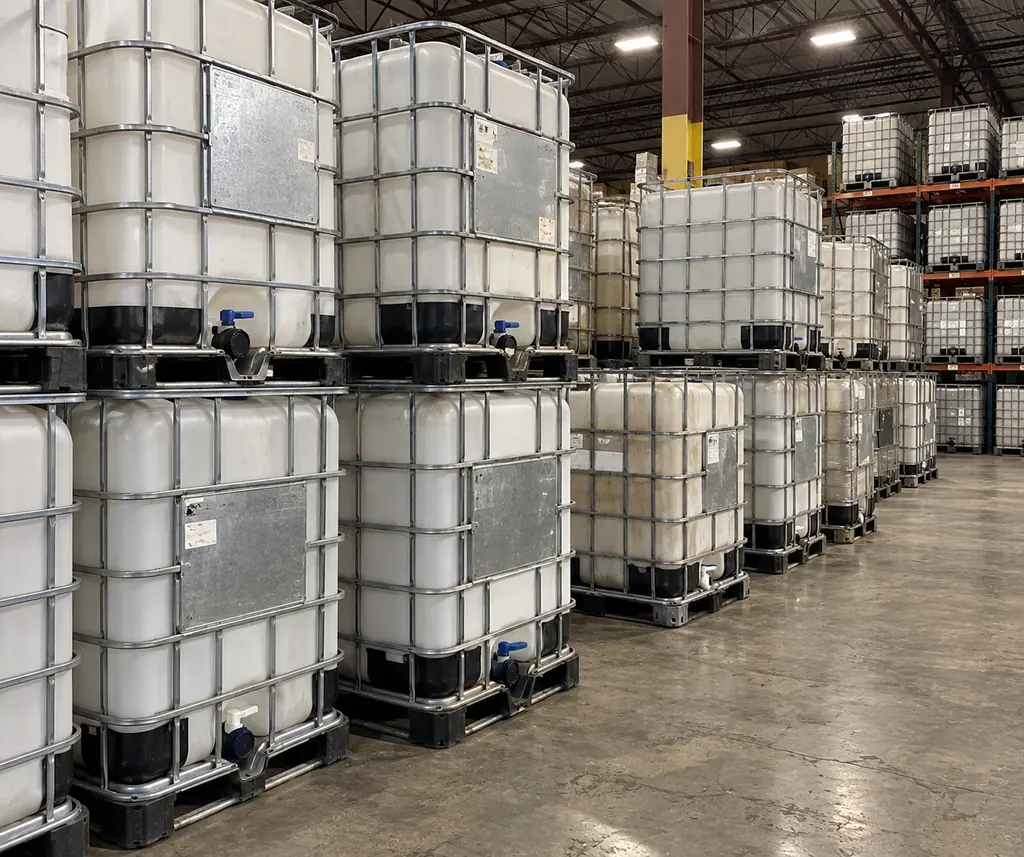
Across the sectors
The same container, five completely different standards.
Every unit in this photograph is physically the same object: a composite IBC with an HDPE bottle in a galvanised cage. What separates a food-grade unit from a brine unit is not the container. It is the documentation, the wash standard, the gasket compound and the retest interval.
That is why our industry pages are mostly about paperwork and compatibility rather than about products. A grower and a co-packer buying the same 275-gallon reconditioned tote are buying two different things, and only one of them will ever be asked to prove what was in it before.
The forklift in the background is the other half of the story. Whatever your sector, the container has to be moved, and a full 275 of anything denser than water can be outside the rated capacity of a lot of warehouse equipment.
Regulatory landscape
Which rules may apply to you.
An orientation rather than legal advice. Which of these apply depends on your product, your movements and your jurisdiction — but knowing which conversation to have is most of the work. Check current regulations before you specify.
| Sector | Regimes to check | Documentation an auditor typically asks for |
|---|---|---|
| Food and beverage | Federal and state food-contact and food safety rules | Prior contents, wash record, materials statement, traceability |
| Brewing and distilling | As food, plus alcohol record-keeping on product | As food; alcohol records concern product, not container |
| Agriculture, fertiliser | State fertiliser labelling rules | Prior contents if the tote is customer-facing |
| Agriculture, pesticide | Pesticide label and state rules; container becomes dedicated | Dedicated-service record |
| Chemical transport | Hazardous materials transport rules; UN-marked packaging | UN marking, test dates, packaging documentation |
| Chemical storage | Workplace safety and spill-prevention rules | SDS, containment sizing, inspection records |
| Municipal drinking water | State drinking-water rules | Prior contents, wash record, material documentation |
| Waste | Hazardous waste rules where applicable; manifests | Manifest chain, container condition |
| Export | Destination packaging regime; frequently UN | UN marking, sometimes phytosanitary on timber |
Seasonality
When to plan ahead, by sector.
Used container supply depends on what industry emptied recently, and demand in several sectors is seasonal. Sending a quote request ahead of your season gives partner suppliers time to source the right units.
| Sector | Peak demand | Request by | Why |
|---|---|---|---|
| Agriculture, fertigation | Feb – Apr | January | Many growers buy at once in spring |
| Municipal brine | Sep – Nov | August | Ahead of winter road treatment |
| Food, summer beverage | Mar – May | February | Bottlers ramp before summer |
| Brewing, seasonal | Aug – Oct | July | Harvest and autumn production |
| Construction water | Apr – Sep | March | Season start |
| Chemical blending | Even | Any | Little seasonality |
| Coatings | Feb – Jun | January | Paint season |
| Dust suppression | May – Aug | April | Dry season |
Cross-sector
The five mistakes every sector makes.
Different industries, identical errors. If you recognise more than two of these, a simple fleet register is the place to start.
| Mistake | Sector where it costs most | Consequence | Fix |
|---|---|---|---|
| Fleet drift — losing track of which unit is which | Food and beverage | Food capability lost across the whole fleet | Physical separation, colour bands, numbered register |
| Buying a higher grade than the application needs | Municipal and agriculture | Overspend on every order | Specify the application, not the letter |
| Ignoring specific gravity when sizing equipment | Chemical and coatings | Overloaded forklifts and rack beams | gallons × 8.34 × SG + tare, before ordering |
| Letting UN test dates lapse | Chemical, waste, export | Shipping in packaging that no longer qualifies | Test dates in the register with reminders |
| Fitting whatever gasket is in the drawer | All of them | Swelling, leaks, product contamination | Record the compound per unit |
Sector index
Common products by sector, on one table.
A cross-reference for anyone whose work spans more than one of these, which is most industrial operations.
| Sector | Typical products | Grade | Format | Documentation to ask for |
|---|---|---|---|---|
| Row-crop agriculture | UAN, ammonium polyphosphate, thiosulphate | Reconditioned B | 275 gal | Prior contents noted |
| Greenhouse and nursery | Nutrient solution, irrigation water | Documented food grade or rebottled | 275 gal | Full documentation if crop contact |
| Livestock | Drinking water, liquid feed, molasses | Documented food grade | 275 gal | Prior contents and wash record |
| Food ingredients | Syrups, concentrates, oils, vinegar | Documented food grade or rebottled | 275 / 330 gal | Prior contents, wash record, materials statement |
| Brewing | Liquor, mash water, spent grain, glycol | Food grade / Reconditioned B | 275 / 330 gal | Full documentation on product-contact units |
| Distilling | Spirit, mash water, barrel top-up | Stainless / food grade | Stainless, various | Material certificates |
| Chemical blending | Acids, caustics, glycols, surfactants | Reconditioned A | 220 / 275 gal | Prior contents, SDS matched |
| Coatings and inks | Latex, alkyds, pigment dispersion | Rebottled / Reconditioned A | 275 gal | Prior contents, UN marking where shipped |
| Water treatment | Hypochlorite, alum, ferric, polymer | Reconditioned A | 275 gal | Prior contents |
| Municipal public works | Brine, flushing water, dust suppression | Reconditioned C | 275 / 330 gal | Minimal |
| Emergency management | Stored drinking water | Rebottled | 275 gal | New-bottle and materials documentation |
| Construction and civil | Site water, dust suppression, curing | Reconditioned C | 275 gal | Minimal |
| Waste and environmental | Wash water, leachate, sampling | Reconditioned C | 275 gal | Manifest where regulated |
| Car wash and detailing | Detergents, waxes, reclaim water | Reconditioned B | 275 gal | Prior contents |
| Textile and laundry | Detergents, bleach, softeners | Reconditioned A or B | 275 gal | Prior contents |