Services · Wash
Nine stages between a used tote and a reusable one.
Reconditioning lets a used IBC go back into service, and reusing a tote avoids making a new one. It is also where corners get cut, because a rinsed tote and a properly washed tote look the same until they do not. This page explains what a thorough job involves so you know what to ask for.
The short answer
A thorough reconditioning typically includes a caustic wash, a surfactant wash, multiple rinses, drain and dry, a leak test, new valve seal and cap gasket, and cage repair. Request a quote and a partner supplier in our network follows up. Pricing is by quote from partner suppliers.
The process
What typically happens, in order.
Exact steps vary by partner supplier. A good supplier records each stage for each unit — ask for that record.
01
Intake & documentation
Each unit is identified, matched to its prior-contents information and photographed. Containers with contents that cannot be washed for reuse are set aside.
02
Drain & residual capture
Leftover product is pumped out and collected for proper disposal rather than flushed. Check current regulations for your product.
03
Caustic wash
Heated sodium hydroxide breaks down proteins, sugars, fats and most organic films.
04
Surfactant wash
A detergent stage for oils, waxes and anything the caustic loosened but did not remove.
05
Rinses
Several separate rinses. For food-related work the final rinse is usually potable water.
06
Drain & dry
Inverted drain and forced air. A bottle sealed damp can grow mold.
07
Inspect & verify
Interior checked under light, odor check, wipe test. ATP swab or conductivity check for higher-purity work.
08
Test & rebuild
Leak test, new valve seat, new cap gasket, cage straightening, pallet repair or replacement.
09
Grade & photograph
A grade is assigned and the unit photographed. If UN marking matters to you, ask the supplier what applies and check current regulations.
Wash levels
Four common levels of wash.
Buying a heavier wash than your application needs is waste. Buying a lighter one is a problem you find out about later.
| Level | Typical steps | Typical verification | Right for |
|---|---|---|---|
| Rinse only | Water rinses | Visual | Refilling the same product within your own totes |
| Standard | Caustic + surfactant + rinses | Visual, odor, wipe | General industrial reuse, agriculture, process water |
| Heavy | Extra caustic and rinse passes | Visual, odor, wipe, rinse conductivity | Stubborn films, viscous residues, pigment |
| Food-related | Separate handling, potable final rinse | ATP swab or conductivity to a written limit | Food and beverage — ask for documentation and check current regulations |
Three signs a bottle should not be washed again
When any of these appear, a careful supplier takes the bottle out of the wash queue rather than running it again. Persisting with a bottle that shows any of them is how unsuitable containers reach customers.
1. Crazing
A network of fine surface cracks, usually visible when you tilt the wall against a light. It means the plastic has been stressed — by chemistry, by UV, by overfilling, by freezing — and the wall has begun to fail. Crazed bottles should be replaced, not washed.
2. Stress-whitening
A pale, chalky band, usually at a corner or around the outlet. The polyethylene has been deformed past its elastic limit. It will not recover and it can be a sign of a coming split.
3. Odor that survives washing
If a smell survives a caustic wash and a surfactant wash, the compound is likely in the wall rather than on it. Further washing rarely helps. The options are rebottling into the same cage, or recycling.
After washing
Where a washed unit should wait.
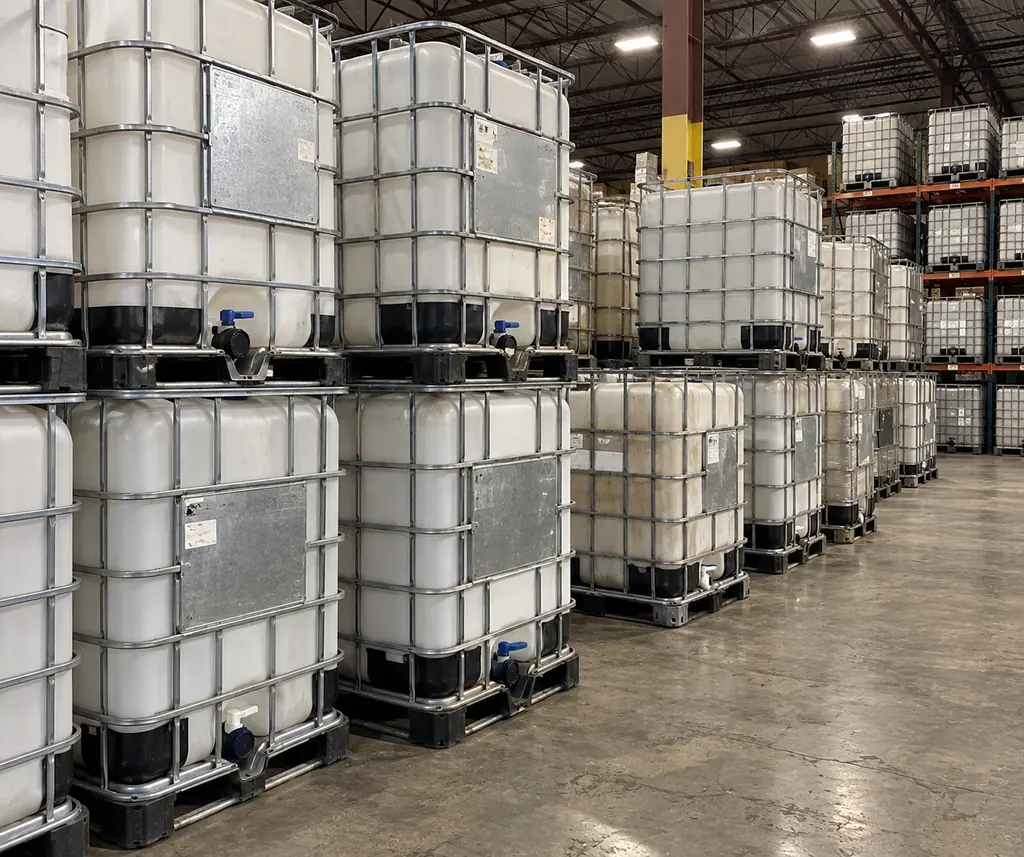
Washing is the expensive part and storage is the part that protects it. Sunlight degrades HDPE over time, so a washed tote left outdoors for long periods loses some of what the wash achieved. Ask how washed units are stored before they ship.
Food-related units should be kept separate from industrial ones. Mix-ups are usually a labelling problem before they are a contamination problem, and physical separation is the simplest control.
By residue
Typical approaches by what the tote held.
A general guide. A supplier who can explain their chemistry and sequence for your product is describing a process they understand — ask.
| Residue | Typical sequence | Notes |
|---|---|---|
| Sugars, salts, fertilizer | Hot rinse | Usually water-soluble |
| Proteins, dairy | Caustic → surfactant → rinses | Heat helps |
| Brewing residue | Caustic → surfactant → rinses | Heat helps |
| Fats and edible oils | Caustic → surfactant → rinses | May need a second pass |
| Latex, waterborne coatings | Surfactant first, then caustic | Order matters — see below |
| Pigment dispersion | Repeated caustic and surfactant | Staining may remain |
| Viscous syrups | Hot pre-rinse, then caustic and surfactant | Drain well first |
| Mineral scale | Mild acid, then rinses | Never mix acid with chlorine |
| Polymerized resin | Usually not washed for reuse | Recycling |
| Aromatic solvent | Usually not washed for reuse | Can permeate HDPE |
| Pesticide | Usually not washed for general reuse | Check current regulations |
Your own specification
Asking a supplier to run your protocol.
If your QA department has a written wash standard, include it in your request and ask whether the supplier can run it as written. These are the items commonly specified, and the ones that are generally not possible on HDPE.
| What you specify | Generally possible? | Note |
|---|---|---|
| Chemistry, concentration, temperature, contact time | Often | Ask for the measured values on the record |
| Rinse count and water quality | Often | Potable final rinse is common for food-related work |
| A named commercial cleaner | Sometimes | Depends on the supplier's discharge limits |
| Verification method and acceptance limit | Often | ATP, conductivity, pH, wipe, or your own |
| Allergen flush | Sometimes | Ask how it is recorded |
| Chlorine-based sanitizer | Case by case | Never follow with acid |
| Steam sterilization | No | HDPE softens; this is a stainless requirement |
| Sterility claim | No | Clean is not sterile |
| Solvent flush | No | Can damage the bottle |
Delays
What tends to hold a job up.
Ask the supplier for a timeline when they follow up. These are common causes of delay and how to avoid them.
| Cause | Avoid it by |
|---|---|
| No prior-contents list supplied | Sending it with the units |
| Mixed residues in one delivery | Grouping by product at your end |
| Residue needing a second wash | Rinsing at the point of emptying |
| Units arriving with leftover product | Draining before shipping |
| Cage or base damage found on arrival | Flagging known damage in advance |
| Non-standard gasket compound to source | Stating the compound in your request |
Ask for a record
What a useful wash record shows.
Ask the partner supplier what they record for each unit. A record should show measured values, not just the intended settings.
| Field | Why it matters |
|---|---|
| Unit identifier | Ties the document to a physical container |
| Prior contents | Determines whether the wash chosen was appropriate |
| Chemistry | Different residues need different chemistry |
| Concentration | Measured, not the setpoint |
| Temperature | A cold caustic wash does much less |
| Contact time | Contact time is a process variable |
| Rinse count and water | How many rinses, and whether the final one was potable |
| Verification and result | What showed it worked, and the reading |
| Date | Lets you trace a problem later |
Reconditioning questions
Can I send my own totes to be washed?
Often, yes. Many partner suppliers wash and return a customer's own totes, so you keep the same units and their prior-contents history stays continuous. Include the quantity and what the totes last held in your quote request and a partner supplier follows up.
What chemistry is used?
Suppliers commonly use a heated caustic (sodium hydroxide) wash for hard residues, a detergent (surfactant) wash for oils and films, and several rinses. The right sequence depends on what the tote held. Ask the supplier what they use and whether they record it for each unit; if you have a written wash specification, ask whether they can run it.
Will washing remove staining?
Usually not. Staining is dye or pigment that has migrated into the polyethylene wall — it is inside the material, not on it, and washing does not reach it. If you need a wall that looks new, rebottling is the usual answer.
How is a tote checked for cleanliness?
Common checks include visual inspection under light, an odor check and a wipe test of the interior wall. For food-related or high-purity work, some suppliers use ATP swabs or rinse-water conductivity against a written limit. Ask which method the supplier uses and for the result on each unit.
What does reconditioning cost?
Pricing is by quote from partner suppliers. It generally depends on quantity and on how difficult the prior contents are to remove. For a bottle that will not come clean, rebottling can be a better choice than repeated washing.