Interactive reference
Eight components, three materials, one very old idea.
A composite IBC is a liner inside a cage on a pallet. Almost everything that goes wrong with one is a consequence of that arrangement, and almost everything that goes right with a repair comes from understanding which component is actually doing the work.
The short answer
The cage carries the load, not the bottle — the bottle is a liner that would deform without it. The valve seat often wears first and is a quick replacement. The pallet base fails silently, usually composite cracking in bending. The sump is what makes a tote drain almost completely. Explore all eight below.
Interactive
Click any component.
Each one has a job, a failure mode, and usually a cheap fix that nobody applies in time.
Select a component — 8 parts
02 · About 40 lb of high-density polyethylene
HDPE bottle
The vessel itself, blow-moulded in one piece from high-density polyethylene, typically 2–3mm wall. Natural HDPE is translucent, which is what gives you level visibility — and what grows algae in a water tank left in the sun.
How it fails
Crazing and stress-whitening. Both are permanent and both mean the bottle is finished, however clean it looks.
Works with a keyboard — tab to a component and press Enter. The full component reference is in the table below for anyone with JavaScript disabled.
Reference
The same information, as a table.
| Component | Material | Approx. weight (275) | Job | Primary failure mode |
|---|---|---|---|---|
| Fill cap | HDPE or PP, flat gasket | 0.6 lb | Seals the top opening; vented or solid | Vacuum collapse from draining with a solid cap |
| HDPE bottle | Blow-moulded HDPE, 2–3mm | 40 lb | Contains the liquid | Crazing and stress-whitening — both permanent |
| Galvanised cage | Welded steel wire, hot-dip | 60 lb | Carries structural and stack load | Corrosion or cracking at the weld nodes |
| Outlet boss | Moulded HDPE, buttress thread | Part of bottle | Thread for the valve; seals on a flat gasket | Distortion from over-tightening with tools |
| Discharge valve | PP or PE body, elastomer seat | 2 lb | Controls discharge | Seat takes a compression set and weeps |
| Sump | Moulded into the bottle | Part of bottle | Drains residual to the outlet | Sediment collection, not structural |
| Pallet base | Steel, composite, wood or plastic | 28 – 42 lb | Footprint, fork pockets, load transfer | Composite cracks in bending, silently |
| Data plate | Metal or moulded plate | 0.2 lb | Carries UN marking and test dates | Assumed permanent; retest dates expire |
Why it is built this way
You could make a 275-gallon polyethylene tank stiff enough to stand alone. Standalone poly tanks do exactly that — they have thick, heavily ribbed walls and weigh a great deal more.
The composite IBC instead splits the job. A thin liner holds the liquid; a cage takes the load. The result is a container far lighter than a self-supporting tank, that can be stacked within its rating, that gives you level visibility through a translucent wall, and — crucially — whose components fail on completely different timescales.
That last consequence is what makes this whole industry possible. Because the bottle wears out long before the cage does, replacing the bottle (rebottling) is a rational intervention. If the tank were monolithic, there would be nothing to do but grind it.
The three parts nobody looks at
The weld nodes
Where the cage bars cross and are welded. Surface rust on a bar is cosmetic; corrosion at a node has eaten section out of the member that carries the load. Inspect nodes, ignore bars.
The pallet base corners
Composite cracks in bending, and it does it quietly. A hairline at a fork pocket corner becomes a fracture months later, usually with 2,400 lb sitting on it. Press each corner with a boot.
The cap gasket
A flat elastomer ring that hardens with UV and age and then weeps on every move. It is inexpensive, and it is easy to forget until the tote is already dripping across a warehouse floor.
Anatomy questions
What is an IBC tote actually made of?
Three materials doing three jobs. A blow-moulded high-density polyethylene bottle holds the liquid, around 40 lb on a 275. A welded, hot-dip galvanised steel wire cage carries the structural load, around 60 lb. A pallet base in steel, composite, wood or moulded plastic provides the footprint and fork pockets. The valve, cap and gaskets add a few pounds of assorted polymer and elastomer.
Does the cage or the bottle carry the weight?
The cage, and this is the fundamental design principle of a composite IBC. The bottle is a liner — it holds liquid but is not stiff enough to contain its own hydrostatic pressure at that volume without deforming. The cage constrains it. That is why a cracked or badly deformed cage is a critical failure and why stack ratings belong to the cage rather than the bottle.
What is the sump on an IBC tote?
A depression moulded into the base of the bottle at the discharge end, sloping toward the outlet so residual liquid runs to the valve rather than sitting in a flat corner. It is the reason a tote drains far more completely than a flat-bottomed vessel, leaving a much smaller heel.
Which component usually wears out first?
Often the valve seat. It is elastomer, it sits in your product continuously, and it takes a compression set over time. It is also a quick, inexpensive replacement — which is why some totes are retired that were never actually worn out, just weeping.
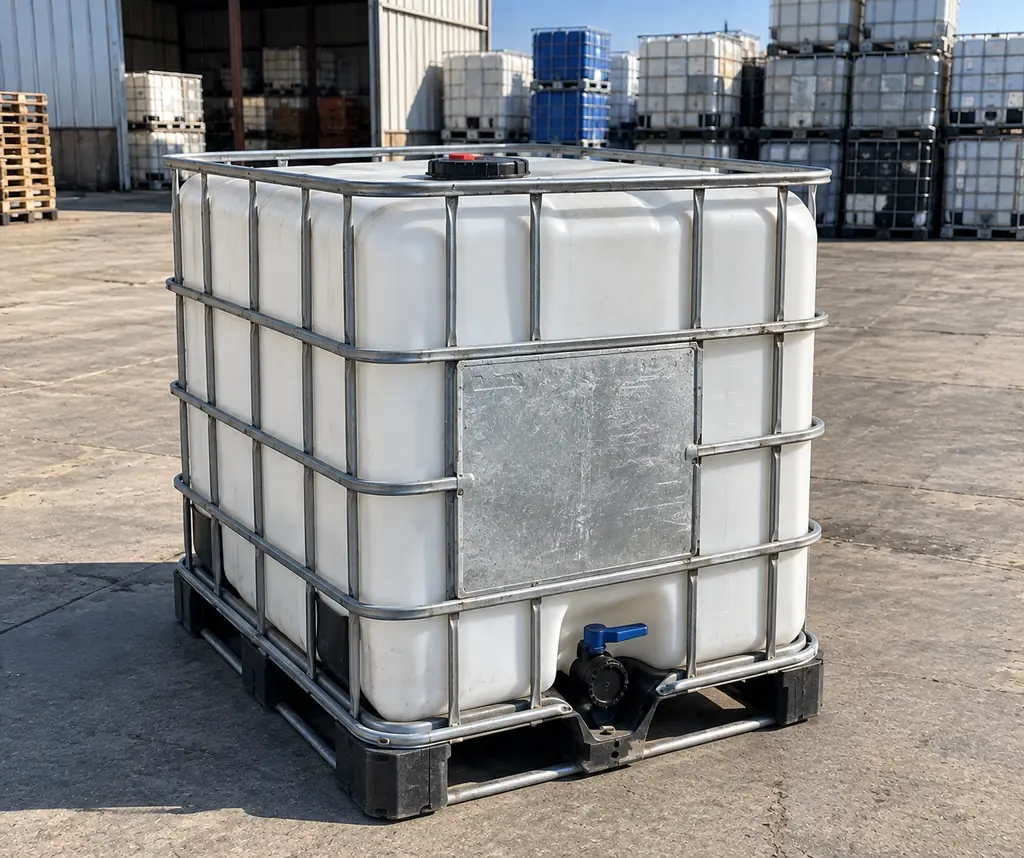
The diagram, photographed
The same eight components, photographed.
The interactive diagram above is an abstraction. This is the object it abstracts, and a few things are easier to see here than in a drawing.
The cage is not decoration around the bottle — it is closer around it than people expect, and the bottle visibly bulges into the spaces between the bars. That is the design working. The bottle is a liner that would balloon and deform without the lattice constraining it, which is why a deformed cage is a critical failure rather than a cosmetic one.
You can also see how little the outlet boss projects. That moulded polyethylene collar is where a heavy ball valve, an adapter and six feet of filled hose all hang, and it is why anything heavier than a basic butterfly wants bracing.
Materials
What every component is made of and why.
| Component | Material | Process | Why that material | Weakness |
|---|---|---|---|---|
| Bottle | HDPE | Extrusion blow moulding | Chemically inert, tough, cheap, translucent for level | UV, aromatics, stress cracking |
| Cage | Low-carbon steel wire, hot-dip galvanised | Resistance welded, then dipped | Stiff, cheap, repairable, recyclable | Corrosion at weld nodes |
| Composite base | Glass- or mineral-filled thermoplastic | Injection moulded | Light, inert, no rot | Brittle in bending |
| Steel base | Mild steel | Pressed and welded | Rackable, tolerates abuse | Corrodes with caustic and salt |
| Timber deck | Hardwood | Sawn, nailed | Cheapest, field repairable | Rot, nail pull, absorbs spills |
| Valve body | PP or HDPE | Injection moulded | Chemical resistance, low cost | UV, cantilever load |
| Valve seat | EPDM, Viton or silicone | Compression moulded | Conforms to seal | Compression set over time |
| Cap | HDPE or PP | Injection moulded | Matches bottle chemistry | UV embrittlement |
| Cap gasket | EPDM foam or solid | Die cut | Seals on a flat face | UV hardening |
| Vent membrane | PTFE or PE membrane | Laminated into the cap | Passes air, stops liquid | Fouling |
| Data plate | Aluminium or stainless | Stamped | Survives the container | Gets painted over |
Failure map
Every component, how it fails, and whether it can be fixed.
The first three are cheap repairs that are easy to overlook, and overlooking them is a common reason sound totes are retired early.
| # | Component | Failure | Warning | Repairable | Remedy cost |
|---|---|---|---|---|---|
| 1 | Valve seat | Compression set | Weeps when closed | Yes | Low |
| 2 | Cap gasket | UV hardening | Weeps on every move | Yes | Low |
| 3 | Composite base | Brittle fracture in bending | Creak or flex; pale stress line | Yes — swap the base | Moderate |
| 4 | Outlet boss | Distorted by over-torquing | Will not seal with any gasket | No | Rebottle |
| 5 | Bottle wall | Crazing | Silvery web under a raking light | No | Rebottle or reclaim |
| 6 | Bottle corners | Stress-whitening | Pale chalky band | No | Rebottle or reclaim |
| 7 | Cage weld nodes | Corrosion, section loss | Orange bloom at the node | No | Scrap the cage |
| 8 | Cage geometry | Side-loading by a forklift | Out of square when sighted | Sometimes — jig | Moderate |
| 9 | Bottle wall | Permeation by solvent | Odour surviving two washes | No | Reclaim |
| 10 | Timber deck | Rot, nail pull | Soft spots, lifted boards | Yes | Low |
| 11 | Vent membrane | Fouling | Slow drain returns | Yes | Low |
| 12 | Data plate | Painted over or lost | Unreadable marking | No | Unit loses certification |
Design
Why the format settled where it did.
Almost every dimension on an IBC is determined by something outside the container. Knowing which constraint set which number explains a lot of otherwise arbitrary-looking choices.
| Feature | Value | Determined by | Consequence |
|---|---|---|---|
| Footprint | 48 × 40 in | The GMA pallet, adopted decades earlier | Two fit across a 96 in trailer |
| Capacity ladder goes up, not out | 275 → 330 gal | Widening would break every rack and trailer | The 330 is 7 in taller, not wider |
| Cage rather than a thick wall | Roughly 60 lb of wire | Weight and cost of a self-supporting tank | Far lighter than a standalone tank |
| Translucent natural HDPE | — | Level visibility without a gauge | Algae grow in any water left in sunlight |
| 6 in fill opening | 150 mm | Large enough for a mixer, small enough to seal | Through-cap equipment fits |
| 2 in discharge | DN50 | Gravity flow rate against valve cost | Restricted on viscous product |
| Sump at the discharge end | — | Residual recovery | Drains more completely |
| Stack rating | On the marking | Cage buckling load | Do not stack loaded units in transit |
| Wall 2 – 3 mm | 0.08 – 0.12 in | Hydrostatic load with the cage constraining | Thin enough to craze under stress |