Sizes · The default
The 275 gallon IBC tote, fully specified.
If somebody says 'tote' in North America without qualifying it, this is what they mean. Forty-eight by forty by forty-six inches, a thousand and forty-one litres, and a footprint built around the standard North American 48 by 40 pallet.
The short answer
48 × 40 × 46 in (1219 × 1016 × 1168 mm) · 275 US gal / 1041 L · tare ~135 lb · gross with water ~2,430 lb · one GMA pallet position · 26 floor positions per 53' trailer. Partner suppliers quote reconditioned, rebottled and new units.
46"
overall height
Including pallet base and cap. Check your doorways.
135 lb
tare weight
Composite base. ±15 lb by base type and maker.
2,430 lb
gross with water
Multiply by specific gravity for anything else.
26
per 53' trailer
Floor positions. Loaded units hit the payload limit first.
Full specification
Every number on one table.
| Specification | Imperial | Metric |
|---|---|---|
| Nominal capacity | 275 US gal | 1,041 L |
| Overall length | 48 in | 1,219 mm |
| Overall width | 40 in | 1,016 mm |
| Overall height | 46 in | 1,168 mm |
| Bottle height (no base) | 40 in | 1,016 mm |
| Base height | 6 in | 152 mm |
| Tare weight (composite base) | 135 lb | 61 kg |
| Tare weight (steel base) | 150 lb | 68 kg |
| Bottle weight (HDPE) | 40 lb | 18 kg |
| Cage weight (galvanised) | 60 lb | 27 kg |
| Gross weight, water | 2,429 lb | 1,102 kg |
| Fill opening | 6 in screw cap | 150 mm |
| Discharge | 2 in S60x6 butterfly | DN50 |
| Stacking limit | See the unit's marking | See the unit's marking |
| Wall thickness, typical | 0.08 – 0.12 in | 2 – 3 mm |
| Temperature range (HDPE) | -40 to 130 °F | -40 to 54 °C |
Buying
Used 275s, by grade.
Typical grade descriptions. Partner suppliers grade to their own standards, so ask what a grade means before you order. Pricing is by quote from partner suppliers.
| Grade | Interior | Cage | Often used for |
|---|---|---|---|
| Rebottled | New bottle, unstained | Used cage, checked and straightened | Resale, sensitive chemistry |
| Reconditioned A | Clear to light haze | Straight, full galvanising | Industrial chemistry, coatings |
| Reconditioned B | Light stain acceptable | Minor straightening | Ag, nutrient mix, process water |
| Reconditioned C | Visible staining | Functional, rough | Brine, wash water, site use |
| New | Virgin | Virgin | Regulated export, high purity |
What the 275 is genuinely good at
One 275-gallon tote holds exactly as much as five 55-gallon drums. That substitution is a large part of the format's appeal, and the benefits compound in ways that are easy to underestimate until you have run both.
- Handling time. One forklift move instead of five, or instead of twenty-five manual drum rolls.
- Spill exposure. One connection point instead of five, and five fewer opportunities for an open bung.
- Floor space. 13.3 sq ft for 275 gallons. A 48 × 40 pallet holds four drums, so five drums need more than one pallet position.
- Residual loss. A sump-bottom tote drains to a small heel at one outlet. Five drums leave five separate heels.
- Level visibility. You can see the contents through the wall, which no steel drum will ever offer.
Where the 275 is the wrong choice
- Dense liquids. Anything above about SG 1.4 puts a 275 over 3,300 lb gross. Check that against your forklift, racking and floor; a 220 may be the better fit for dense acids and concentrated caustic.
- Low ceilings. Forty-six inches plus a spill pallet plus fork clearance adds up quickly in a basement or a retrofit space.
- Small-batch product. If you will not use 275 gallons before the product degrades, you are buying a storage problem, not a container.
- Hot fill. HDPE softens as it warms; check the manufacturer's temperature limit. Hot fill is usually a stainless application, not a poly one.
- Aromatic solvents. Many permeate or swell polyethylene. Check compatibility; stainless is the usual alternative.
275 gallon questions
How tall is a 275 gallon IBC tote?
Forty-six inches, or 1168 mm, including the pallet base and the cap. That is the figure that matters for doorway clearance, box truck ceilings and shelf spacing. Without the pallet base the bottle and cage alone are about 40 inches, but nobody moves one without its base so the 46-inch figure is the one to plan around.
How much does an empty 275 gallon tote weigh?
Typically 125 to 150 lb, with about 135 lb common for a composite-base unit and the heavier end for a full steel base. The bottle is roughly 40 lb of that, the galvanised cage roughly 60 lb, and the base makes up the difference. Manufacturer variation is real — if you are working to a tight weight limit, weigh the actual unit.
How many gallons does a '275' actually hold?
Nominal capacity is 275 US gallons / 1041 litres, and most bottles have a few gallons of headroom above that before the fill line. Do not plan on the overfill: the headroom exists for thermal expansion, and filling into it is how a tote weeps at the cap on a hot afternoon.
What does a used 275 gallon tote cost?
Pricing is by quote from partner suppliers. It depends on grade (reconditioned, rebottled or new), quantity, current supply and the delivery distance, so ask for delivery to be shown separately and compare quotes on the same basis.
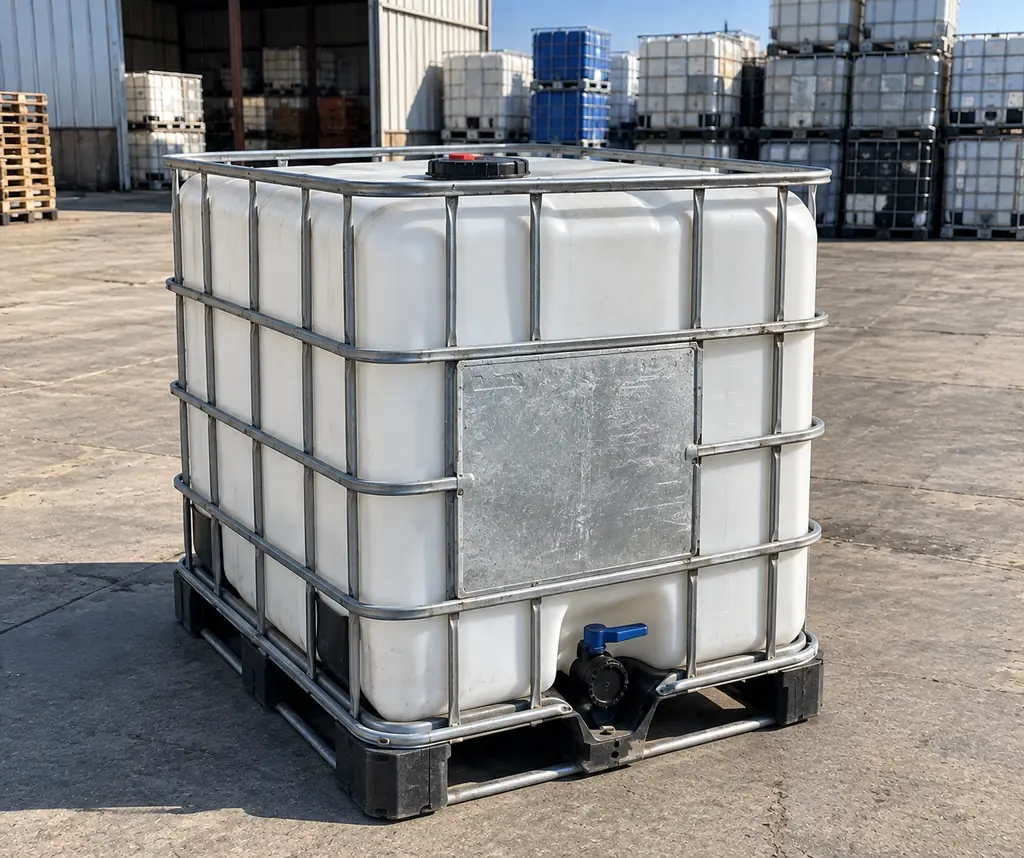
The unit itself
Every dimension on this page, on one object.
The proportions are worth looking at directly, because the numbers do not convey how the format behaves. It is almost exactly as tall as it is wide, which is what makes it stable on a forklift and awkward through a standard doorway.
You can see the four elements that decide most purchasing questions: the galvanised cage that carries the structural load, the 6-inch screw cap that has to be vented before you gravity-drain, the 2-inch discharge valve that is a common wear point, and the base whose fork-pocket corners can crack without much warning and are worth checking whenever a unit arrives.
The metal plate on the cage is the data plate. If the unit will ever ship on a public road with hazardous material in it, that plate and its test dates matter: check current regulations for what the marking and retest dates must show.
Manufacturer variation
Nominally identical, measurably different.
A 275 is a 275 until you try to rack forty of them to a tight tolerance or swap a bottle between cages. These are typical ranges across the makes that circulate in North America.
| Variable | Range across makers | Matters when | Ask before ordering if |
|---|---|---|---|
| Overall height | 45.5 – 46.5 in | Racking, container doors, double stacking | Your clearance is under 48 in |
| Footprint | 47.8 × 39.8 to 48.2 × 40.2 in | Tight racking, automated handling | You have rack guides or a tote lifter |
| Tare weight | 119 – 152 lb | You are near a trailer weight limit | Shipping 26 loaded units |
| Wall thickness | 0.08 – 0.12 in | Long-term storage of aggressive chemistry | Product is a stress-cracking agent |
| Outlet height | 7 – 9 in to centre | Gravity feeding into a fixed vessel | You decant into drums or buckets |
| Thread standard | S60x6, occasionally S70x6 | Your existing fittings must mate | Always |
| Fill opening | 6 in, occasionally 9 in | Through-cap mixers and dip tubes | You fit equipment through the cap |
| Base type | Composite, steel, wood, plastic | Racking, washdown, pallet jacks | You rack, or you run pallet jacks only |
| Fork entry | Four-way, occasionally two-way | Your dock approach is fixed | You can only approach on one axis |
| Sump geometry | Pronounced to nearly flat | Expensive product; heel matters | Your product is costly to lose |
Handling
Equipment ratings for a loaded 275.
Capacity plates are stated at a 24-inch load centre with full fork engagement. A 48-inch-deep tote carried slightly out derates that, and the derating is the step most often skipped.
| Product | SG | Gross | Two units on one beam level | Per foot, four-foot base |
|---|---|---|---|---|
| Solvent, ethanol | 0.79 | 1,947 lb | 3,894 lb | 487 lb |
| Diesel | 0.85 | 2,084 lb | 4,169 lb | 521 lb |
| Water, aqueous | 1.00 | 2,429 lb | 4,857 lb | 607 lb |
| Propylene glycol | 1.04 | 2,520 lb | 5,040 lb | 630 lb |
| Latex paint | 1.25 | 3,002 lb | 6,004 lb | 750 lb |
| UAN 32 fertiliser | 1.32 | 3,162 lb | 6,325 lb | 791 lb |
| Caustic soda 32% | 1.35 | 3,231 lb | 6,462 lb | 808 lb |
| Corn syrup | 1.42 | 3,392 lb | 6,784 lb | 848 lb |
| Sulphuric acid 93% | 1.83 | 4,332 lb | 8,664 lb | 1,083 lb |
Applications
What a 275 is genuinely good and bad at.
The format is close to universal, which makes the exceptions worth knowing precisely.
| Situation | Verdict | Why | Alternative |
|---|---|---|---|
| General industrial liquid handling | Ideal | The format exists for this | — |
| Replacing 55-gallon drums | Ideal | Exactly five drums; far fewer moves | — |
| Liquid fertiliser and fertigation | Ideal | Right volume; a lower grade is often acceptable | — |
| Water storage and irrigation | Ideal | Shade it from sunlight to slow UV damage and algae | — |
| Food ingredients | Depends | Ask the supplier for documentation; check current regulations | Stainless for CIP duty |
| Product above SG 1.4 | Poor | 3,300 lb+ gross; check your equipment | 220 gal |
| Ceilings under 60 in clear | Poor | 46 in plus spill pallet plus fork clearance | 220 or 180 gal |
| Slow, low-volume usage | Poor | Product may degrade before you use it | Drums or 120 gal |
| Hot fill | Unsuitable | HDPE softens; check the maker's limit | Stainless |
| Aromatic or chlorinated solvents | Usually unsuitable | Can permeate or swell the wall; check compatibility | Stainless |
| Pressure or vacuum service | Unsuitable | Atmospheric vessel | Rated stainless |
| Long-term high-proof spirit | Usually unsuitable | Long contact with plastic is usually avoided | Stainless |
| No forklift, dock or liftgate | Unsuitable | 2,400 lb cannot be moved by a person | Drums |