Products · Grade A / B / C
The container that never stopped being a container.
A reconditioned IBC is the whole original unit — bottle, cage, pallet — washed, tested, repaired and sent back out by a supplier. It is typically the least expensive tote you can buy, and it reuses the most: the polyethylene stays a vessel instead of becoming pellets.
The short answer
Original HDPE bottle, washed and rinsed, leak tested, usually with a new valve seal and cap gasket, cage straightened where needed. Commonly graded A, B or C by the supplier. Reusing a tote avoids making a new one. Pricing is by quote from partner suppliers.
The grades
What A, B and C typically mean.
Each supplier sets its own criteria. This is the common pattern — ask the supplier quoting your order to confirm what their grade means.
| Grade A | Grade B | Grade C | |
|---|---|---|---|
| Bottle clarity | Clear to very light haze | Light stain or colour shadow acceptable | Visible staining and scuffing acceptable |
| Wall condition | No crazing, no stress-whitening, no gouges | No crazing; minor surface scuffing allowed | Surface damage allowed; wall integrity intact |
| Odour | None detectable | None detectable | Faint residual odour possible |
| Cage | Straight, galvanising intact, no weld corrosion | Minor straightening done, light surface rust | Functional, cosmetically rough |
| Pallet base | Sound, no repairs visible | Repaired or replaced deck acceptable | Functional, repairs visible |
| Typical use | Chemistry, coatings, industrial | Ag, nutrient mix, process water | Brine, wash water, stormwater, site |
What should be refused
Prior contents that commonly rule out reuse.
A used tote is only as trustworthy as the record of what was in it. Many reconditioners will not wash and resell a unit that held any of these, however clean it looks.
Often excluded
Pesticides & biocides
Agricultural chemicals can bind to polyethylene and are not reliably removable.
Often excluded
Aromatic solvents
Toluene, xylene and their relatives can swell and permeate HDPE. The wall may be compromised even when it looks fine.
Often excluded
Polymerising resins
Anything that cures in place. If it set once, it can set again where you cannot see.
Often excluded
Unidentified contents
No label, no paperwork, no reliable history should mean no resale as a container.
Often excluded
Regulated waste streams
Totes that held regulated waste have their own handling requirements. Check current regulations.
Often excluded
Petroleum distillates
Fuels and heavy oils can leave an odour and a film that survives washing.
If prior contents matter for your product, ask the supplier what the units you are being quoted held before.
How to specify a reconditioned tote properly
Many problems with used containers trace back to an under-specified order. Here is what is worth putting in the Message field when you request a quote.
Say what is going in it
Not the category — the actual product, and ideally its SDS. HDPE is compatible with a wide range of chemistry and incompatible with a shorter, specific list. A supplier would rather read the sheet than guess.
Say how it gets moved
Forklift, pallet jack or crane? Steel base, composite base and wood deck behave very differently under a jack. If you move totes with pallet jacks only, say so, so the supplier can offer units with a suitable base.
Say what mates to the outlet
Thread mismatch is a common reason for returns. S60x6 and S70x6 look alike from across a room. Photograph your existing fitting and include it.
Say whether appearance matters
If nobody outside your building will ever see the tote, a lower cosmetic grade may do the job, and you can spend the difference on a better valve or a heater jacket. If your customer sees it, say so and consider rebottled.
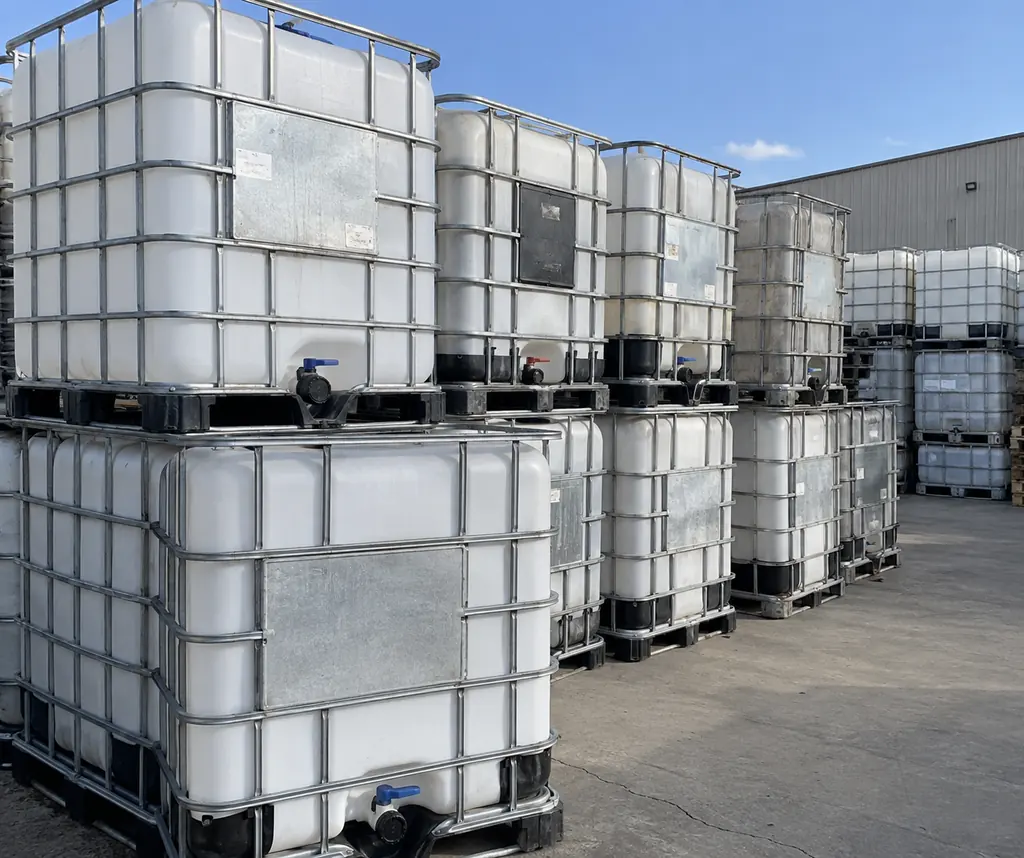
What to expect
What a good reconditioned unit looks like.
A well reconditioned unit has had its original bottle washed and rinsed, been leak tested, and usually received a new valve seat and cap gasket before it is graded.
It is the highest-reuse option: none of the polyethylene in the bottle becomes regrind, and reusing a tote avoids making a new one.
The valve is a common failure point, so it is worth asking whether the valve or its seat has been replaced on the units you are quoted.
Compatibility
What you can generally put in a reconditioned HDPE tote.
General guidance at ambient temperature and typical working concentrations. Always check your own safety data sheet — concentration and temperature both move these calls, sometimes a long way.
| Product class | HDPE | Gasket | Notes |
|---|---|---|---|
| Water, aqueous solutions | Excellent | EPDM | The default case |
| Liquid fertiliser (e.g. UAN) | Excellent | EPDM | Watch gross weight — UAN solutions are denser than water |
| Caustic soda solutions | Excellent | EPDM | Dense; consider a smaller unit or a partial fill |
| Sulphuric acid | Good | FKM | Very dense — check the tote's rated specific gravity and size down |
| Hydrochloric acid | Good | FKM | Fumes; venting matters |
| Sodium hypochlorite | Fair | FKM | Off-gasses; use a vented cap |
| Alcohols (methanol, ethanol, IPA) | Good | EPDM | Check concentration and flammability rules |
| Glycol, coolant | Excellent | EPDM | A well-suited poly application |
| Detergents, surfactant concentrate | Good | EPDM | Can promote stress cracking; inspect regularly |
| Vegetable and mineral oils | Good | FKM | EPDM swells in oils — specify FKM |
| Latex, waterborne coatings | Excellent | EPDM | Needs agitation; settles hard |
| Aromatic solvents | Poor | — | Permeates the wall. Consider stainless. |
| Chlorinated solvents | Poor | — | Not an HDPE application |
| Concentrated nitric acid | Poor | — | Oxidiser; stainless or specialist container |
In service
Getting more years out of a unit.
Service life varies widely, and much of the difference comes down to a handful of habits.
01
Keep it out of the sun
Ultraviolet embrittles HDPE and is a major cause of premature failure. A roof is the cheapest life extension available.
02
Do not overfill
The headroom above the fill line is for thermal expansion. Fill into it and a warm afternoon puts the wall under a load it was not designed for, concentrated at the bottom corners.
03
Vent before draining
A sealed tote draining under gravity pulls a vacuum. Partial collapse stresses the corners and can show up as stress-whitening.
04
Do not overtighten
The outlet boss is moulded polyethylene and the seal is a flat gasket, not the thread. A wrench can distort the sealing face permanently.
05
Forks in the pockets only
A tine under the cage puts a point load through a steel bar into the bottom of the bottle. It is a common cause of damage and a training issue.
06
Drain before a freeze
Expanding ice concentrates force at the corners and in the valve. Fit a valve at the lowest point and drain outdoor units before freezing weather.
Troubleshooting
What is wrong with your tote, and how to fix it.
Many units that get scrapped were not worn out. They were leaking at the valve, cracked at the base, or vacuum-collapsed — usually quick repairs with the right part.
| Symptom | Most likely cause | Fix |
|---|---|---|
| Weeping at the valve when closed | Worn or set elastomer seat | Replace the seat, not the valve |
| Valve will not close fully | Grit or crystal in the seat face | Flush, replace seat, fit an inlet screen |
| Leaking at the valve flange | Compressed gasket, or over-tightened boss | New flange gasket; do not overtighten |
| Weeps at the cap on every move | UV-hardened cap gasket | New cap gasket |
| Flow slows with liquid still visible | Vacuum — solid cap on a draining tote | Fit a vented cap |
| Panels dished inward | Vacuum collapse, partial | Inspect corners for whitening; often still serviceable |
| Base creaks or flexes underfoot | Cracked composite base | Swap the base; the tote is not scrap |
| Cage out of square | Side-loaded by a forklift | Straighten if no weld has opened |
| Green water inside | Algae — translucent wall in sunlight | Wash, then wrap or cover the unit to block light |
| Persistent smell after washing | Compound permeated into the wall | Not a cleaning problem. Rebottle or recycle. |
| Fine silvery web under a raking light | Crazing | Retire the bottle; the cage may be reusable for rebottling |
| Pale chalky band at a corner | Stress-whitening | Retire the bottle; the cage may be reusable |
Reconditioned totes — common questions
What does 'reconditioned' usually include?
A good reconditioning process typically includes recording prior contents, a wash suited to the residue, thorough rinsing, draining and drying, a leak test, a new valve seal and cap gasket, cage straightening and pallet repair if needed, and a grade based on an inspection of the bottle interior. Processes vary by supplier, so ask exactly what the supplier quoting your order does — a unit that has only been rinsed is not the same thing.
Will there be residue from whatever was in it before?
A properly washed tote should have no free liquid and no film. What can remain is staining — a colour shadow in the polyethylene where a dye or pigment has migrated into the wall. Staining is usually cosmetic. A bottle with polymerised residue, a persistent odour, or any sign that a solvent has swelled the wall should not be reused as a container.
Can I get reconditioned totes cleaned to my own spec?
If you have a written cleaning standard, include it with your request. A partner supplier follows up and can tell you whether they can meet it. Extra cleaning steps are typically priced separately.
How do I know which grade I am getting?
Ask the supplier to put the grade on the quote and to explain what it means for bottle clarity, wall condition, cage geometry and pallet condition. Grade language varies between suppliers, and photographs of the units allocated to your order are worth asking for.
Are reconditioned totes UN marked?
Some are. A UN marking belongs to the tested assembly, not the bottle alone, and it carries a date. Whether a reconditioned unit can be used for regulated transport depends on its marking and inspection status, so if you need one, say so in your request and check current regulations for your material.
Keep reading