Logistics
The base is the part that fails.
Nobody specifies a tote by its pallet base, yet a cracked or rotten base is behind a lot of container failures in storage and in transit. This guide covers the four base types, what stacking limits actually mean, and how a trailer of totes is usually built.
The short answer
Four base types: steel (durable, rackable, heavy), composite (light, chemical-resistant, brittle in bending), wood (low cost, rots, splinters) and plastic (washdown). Follow the stacking limit on the unit's marking; do not double-stack loaded units in transit. 26 floor positions per 53' trailer.
Base types
Four options, four failure modes.
| Base | Weight | Strengths | Fails by | Best for |
|---|---|---|---|---|
| Steel | 42 lb | Rackable, survives fork abuse, repairable by welding | Corrosion at the welds, particularly with caustics or salt | Racked storage, heavy liquids, frequent handling |
| Composite | 28 lb | Light, chemical-resistant, no rot, no splinters | Brittle fracture in bending; can crack quietly then fail loaded | General industrial, chemical service |
| Wood (hardwood deck) | 34 lb | Low cost, field-repairable | Rot, splintering, nail pull, absorbs whatever spills | Dry areas, single-trip use |
| Plastic (moulded) | 31 lb | Washdown, no absorption | Creep under sustained load; deforms in heat | Washdown areas, cold storage |
The important asymmetry: steel tends to fail slowly and visibly, composite can fail suddenly and with little warning. If you inspect your totes rarely, steel is the more forgiving choice even though composite suits most chemistry better.
Stacking
What the ratings actually mean.
A stacking limit is a static rating on a flat floor with an intact lower unit. It is not a transit rating. The unit's marking or the manufacturer's data gives the limit; the table below is how to apply it.
| Condition | Guidance | Conditions |
|---|---|---|
| Empty, at rest | Up to the marked limit | Flat floor, aligned bases, no wind exposure |
| Empty, in transit | Two high where the vehicle allows | Strapped, sound cages, intact lower bases |
| Loaded, at rest | Only if the marking permits it | Flat floor, inspected lower base, level fill |
| Loaded, in transit | Single tier | Do not double-stack loaded units on a moving trailer |
| Racked, loaded | 1 per level | Decked racking, beams rated to gross weight |
| Outdoors, empty | Keep stacks low | Wind is often the limiting factor, not the cage |
Loading
How a trailer of totes is usually built.
A typical sequence. Carriers and partner suppliers set their own procedures, but these are the principles behind most of them.
- 01
Inspect before it moves
Bases checked for cracks, cages checked at the corner nodes, caps checked for tightness. A unit with a questionable base should not go on the truck, let alone underneath another one.
- 02
Heaviest forward, low
Loaded units go nose-first and stay on the floor. Weight distribution matters more on totes than on boxed freight because the centre of gravity is high and the liquid moves.
- 03
Two across, nose to tail
Thirteen rows of two in a 53-footer. Bases square to the trailer walls, no rotation, no staggering — a rotated tote is the one that walks in transit.
- 04
Restrain the load
Load bars or straps across the load at intervals. Empties on top need their own restraint because a light unit moves further than a heavy one when the trailer bounces.
Racking IBC totes properly
Racking is where a lot of facilities get into trouble, because beam ratings are usually stated for evenly distributed loads, and a tote is a concentrated load on a few feet.
- Deck every level. Wire mesh or solid shelf. A pallet base spanning two beams is a base under bending load, and most composite and wood bases are not designed for it.
- Rate against gross, not nominal. Two 275s of caustic on a level is 6,462 lb; confirm the beam pair is rated for it.
- Loaded low. Full totes on the ground level or the first beam. Empties go up high where a fall does less.
- Leave the valve accessible. If you have to lift a tote out to drain it, somebody will eventually drain it in the rack instead.
The five-minute base inspection
Do this whenever a tote arrives and before it goes into storage. It is quick, and it catches the common problems.
- Walk all four sides and look at the fork pocket corners — that is where composite cracks often start
- Press down on each corner with a boot; any flex or creak is a fail
- Check for a white stress line in composite, a sign it has been overloaded
- On steel, look at the weld nodes for corrosion bloom rather than surface rust
- On wood, check for nail pull at the deck boards and any dark staining from absorbed product
- Confirm the bottle sits flat on the base with no gap at any corner
A failed base does not always mean a scrapped tote. Ask about replacement bases and compatibility when you request a quote.
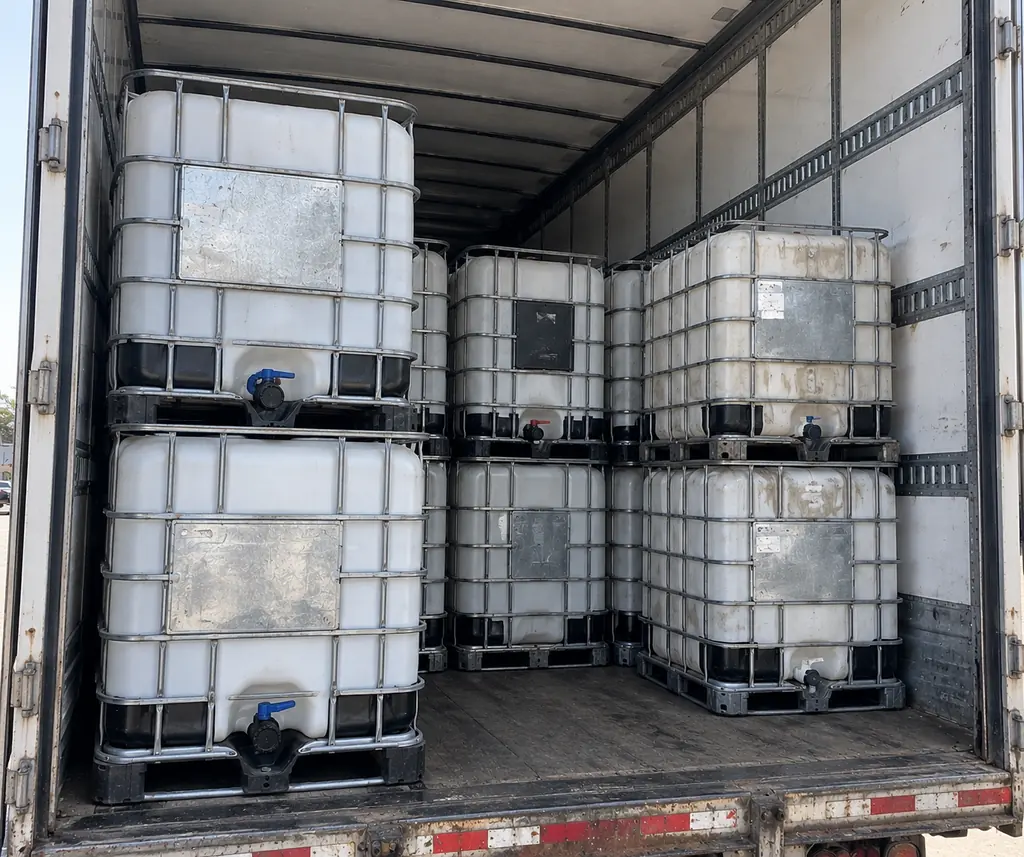
The pattern, in a trailer
Rows of two, and why nothing is staggered.
Two across on a 48 by 40 footprint takes 80 inches of a dry van's roughly 98 to 100 inches of interior width, which is enough to load without scraping and leaves a rotated or unrestrained unit room to walk. Square, aligned rows are what keep the load still.
When a trailer is loaded two high, the lower tier carries the upper one. A stacking limit is a static rating on a flat floor with an intact lower unit, and none of those conditions describe a moving trailer — which is why loaded units should stay single tier in transit and only sound empties go on top.
Loading patterns
Every vehicle, with its count and its limit.
Counts are geometric and approximate. The limiting factor on anything loaded is usually weight, and it bites well before you run out of floor.
| Vehicle | Floor positions | Double-stacked empties | Note |
|---|---|---|---|
| 53 ft dry van | 26 | 52 if interior height allows | ~18 loaded 275s of water at ~44,000 lb payload |
| 48 ft dry van | 22 – 24 | Twice the floor count if height allows | Depends on interior length; same payload logic |
| 40 ft high-cube container | About 20 | 275s only | Two 330s at 106 in will not pass the ~101 in door |
| 40 ft standard container | About 20 | No | Two 275s at 92 in exceed the ~90 in door |
| 20 ft standard container | About 9 – 10 | No | Count depends on the loading pattern |
| 26 ft box truck | About 12 | Check interior height | Payload varies widely by truck |
| 48 ft flatbed | 24 | Not usually | Needs proper securement; payload limits loaded units |
| Standard pallet position | 1 | 2 | — |
Base comparison
Four materials, four failure modes, four inspections.
| Steel | Composite | Wood | Moulded plastic | |
|---|---|---|---|---|
| Weight | 42 lb | 28 lb | 34 lb | 31 lb |
| Rackable on decking | Excellent | Good | Fair | Good |
| Chemical resistance | Poor with caustic and salt | Good | Absorbs spills | Good |
| Washdown | Rusts at welds | Good | Poor | Excellent |
| Cold weather | Good | Cracks from frozen pockets | Fair | Fair, creeps in heat |
| Fails by | Corrosion at welds | Brittle fracture in bending | Rot, nail pull | Creep under sustained load |
| Warns you first | Usually — visible rust | Often not — quiet crack | Usually — softness | Usually — visible deformation |
| Inspection | Look at weld nodes | Press every corner with a boot | Press deck boards | Look for sag at centre |
| Best for | Racked, frequent handling, outdoor | Chemical service, floor stored | Dry areas, single trip | Washdown, cold store |
Storage
Stacking and racking, by situation.
Stacking limits assume a flat floor, an intact lower unit and no movement. Three conditions that a great many real storage situations fail.
| Situation | Limit | Conditions | Do not |
|---|---|---|---|
| Empty units, indoors, flat floor | Marked stacking limit | Bases aligned, no wind | Stack against a wall for support |
| Empty units, outdoors | Keep stacks low | Wind is often the limit, not the cage | Leave unstrapped in exposed sites |
| Loaded units, indoors, flat floor | Only if the marking permits | Lower base inspected, level fill | Stack on a cracked base |
| Loaded units, in transit | Single tier | — | Double-stack loaded units |
| Empty units, in transit | Two high where height allows | Restrained separately, cages sound | Rely on the lower tier's strapping |
| Racked, loaded | 1 per level | Decked, beams rated to gross | Rack on bare beams |
| Racked, empty | Per the rack rating | Decked | Exceed the beam rating on the deck |
| On a spill pallet | 1 | Adds ~6 in height | Stack on top of a spill pallet |
| Mixed formats | Do not mix | Different heights destabilise | Stack a 275 on a 330 |
| Mixed base types | Do not mix | Different footprints and deflection | Assume they interlock |
Pallet and stacking questions
Can you stack IBC totes two high?
Often, within the limit shown on the unit's marking or in the manufacturer's data — that limit, not a rule of thumb, is what to follow. Empties that are cage-sound commonly stack. Loaded units should not be double-stacked in transit: road vibration, an unseen crack in the lower base and a hard brake combine badly. For storage on a flat floor with intact bases, check the marked stacking limit before putting one loaded unit on another.
Which pallet base is best?
Steel for durability and racking, composite for weight and chemical resistance, wood for low cost, plastic for washdown environments. Steel bases survive forklift abuse that damages composite; composite survives chemical exposure that rots wood. If you run a lot of totes, standardise on one base type where you can — mixed bases stack less predictably and can jam racking.
Why did my composite base crack?
Common causes are racking on bare beams so the base deflected, a drop or hard set-down by a forklift, or water freezing in the pocket. Composite is strong in compression and unforgiving in bending. It can fail quietly — a hairline that becomes a fracture later, sometimes while loaded.
How many totes fit across a trailer?
Two, side by side, with the 40-inch faces across the trailer. That takes 80 inches of a dry van's interior width, which is commonly around 98 to 100 inches, so there is room to load without scraping. Thirteen 48-inch rows of two gives you 26 positions in a 53-foot trailer.