Services · Sell
Those totes behind the building may be worth money.
Many companies pay a hauler to make used IBCs disappear. That can mean paying to destroy something with resale value — and reusing a tote avoids making a new one. Send us photos and details of the lot, and we match your request with a partner supplier in our network.
The short answer
Send photos, quantity and prior contents through the quote form. We match the request with a partner supplier who buys used totes, and the supplier follows up with an offer. Pricing is by quote from partner suppliers; pickup is available through partner suppliers. Requests come from across the United States; availability depends on partner suppliers.
The process
A few photos and a quote request.
Selling used totes should be low effort, because the alternative for most sellers is a disposal invoice.
- 01
Send photographs
The product label, a cage corner, the valve, the pallet base, a wide shot of the lot, and the inside of one bottle through the open cap. That is usually enough for a supplier to give a first estimate.
- 02
We match your request
We pass your request to a partner supplier in our network that buys used totes in your area.
- 03
A supplier makes an offer
The partner supplier follows up with an offer and explains how they arrived at it, including whether pickup is included.
- 04
Pickup and grading
If you accept, pickup is arranged through the partner supplier. Expect them to confirm the grade when they see the units.
Valuation
What moves the price.
Sellers often leave money on the table by not mentioning things that would have raised the offer.
| Factor | Raises the price | Lowers it |
|---|---|---|
| Prior contents | Documented food product, potable water, inert water-based contents | Unknown, solvent, pesticide, regulated waste |
| Quantity in one place | A large lot at one location | A few units scattered across sites |
| Cage condition | Straight, galvanizing intact, no weld corrosion | Bent bars, broken welds, heavy rust |
| Bottle condition | Clear, no crazing, no stress-whitening | Cracked, crazed, deeply stained, odorous |
| Pallet base | Steel or sound composite | Cracked composite, rotted wood |
| Labels and markings | Readable UN marking | Painted over, torn off, illegible |
| Storage | Indoors or covered | Years of direct sun, standing water inside |
| Location | Close to a partner supplier | Far from any supplier |
| Valve and cap present | Both fitted and working | Missing valve, missing cap, open outlet |
The biggest lever is usually documentation. A lot with a prior-contents record is easier to resell for reuse than an identical lot without one, because the record is what lets the next user know what the container held.
Totes that are hard to resell, and why
Knowing this before you spend time on photographs saves everyone effort. A supplier who will resell anything for reuse is one whose reconditioned stock you should question.
- Pesticides and biocides. They can bind into polyethylene and are not reliably removable by washing.
- Aromatic solvents. Toluene, xylene and similar solvents can permeate the wall, even when the bottle looks fine.
- Curing resins. Residue that cured once can keep curing somewhere you cannot inspect.
- Petroleum distillates. Odor and film that can survive washing.
- Regulated waste. Containers that held regulated waste follow their own rules — check current regulations.
- No label, no paperwork, no history. Not a judgement about you — a limit on what can honestly be resold.
Totes in these groups may still be accepted for recycling. See the recycling page.
Getting the most for a lot
Keep the caps on
An open fill cap collects rain, grit and whatever blows across a lot. A bottle left open for months can drop a grade or become scrap.
Rinse before you store
A single water rinse when the tote is emptied stops residue drying onto the wall, and dried residue is what turns a washable bottle into a recycling candidate.
Store them out of the sun
Ultraviolet light embrittles HDPE over time. A tote stored under a roof holds its value better than the same tote left in an open lot.
Keep the paperwork together
Even a photograph of the original product label alongside a simple list is documentation. It helps the offer and it takes a few minutes.
Consolidate before you request
One lot at one location is easier to collect than several small lots across sites. If you have multiple locations, say so in the request.
Ready to sell
Tell us what you have. A partner supplier follows up.
The quote request is free and carries no obligation. Include the quantity, prior contents, location and a few photos, and we match it with a partner supplier in our network.
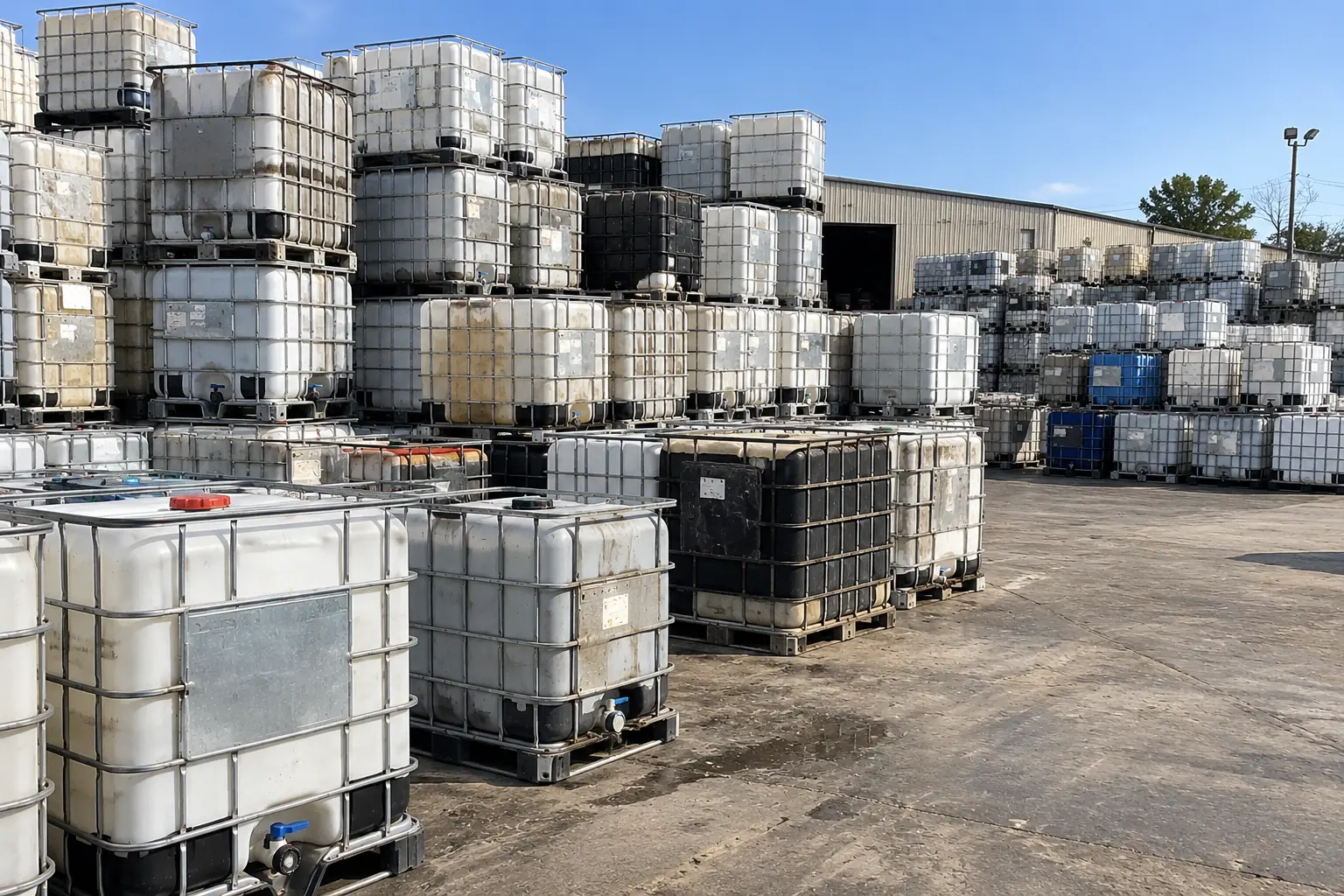
Mixed lots
A lot that looks like this can still sell.
Sellers often apologize for lots that look like this. There is no need. Many mixed lots contain plenty of reusable containers, and stained bottles can still be useful where appearance does not matter, or as cages for rebottling.
Black bottles are worth knowing about. Carbon-loaded polyethylene is usually specified for light-sensitive product, and it is hard to inspect internally with a flashlight — so expect those units to be opened and checked individually.
What a photograph cannot show is history. A lot with a prior-contents record is generally easier to resell than one without, and that difference can matter more than any physical improvement you could make to the units.
Condition
How condition and history usually affect a lot.
Start from the row that matches your totes. This is a general guide to where a unit is likely to go — the partner supplier's offer is what counts.
| Condition and history | Likely outcome |
|---|---|
| Documented food-product history, sound | Washed and resold; food use needs documentation |
| Documented water-based contents, sound | Washed and resold |
| Documented compatible industrial contents, sound | Washed and resold |
| Labelled but undocumented, sound | Washed and resold as a lower grade |
| Sound cage, stained or worn bottle | Cage reused for rebottling |
| Damaged cage, sound bottle | Bottle may go into another cage |
| No label, no paperwork | Usually recycling only |
| Hard-to-resell prior contents | Recycling — check current regulations |
| Crazed, split or deformed | Recycling |
| Stainless steel tote with a data plate | Refurbishment or scrap by alloy |
What to expect
From your quote request to a sale.
| Stage | Who acts | What you receive |
|---|---|---|
| You send photos and details | You | — |
| We match your request | RE:IBC Totes | Your request goes to a partner supplier |
| A partner supplier follows up | Partner supplier | An offer, ideally in writing |
| You accept or decline | You | No obligation |
| Pickup is arranged | Partner supplier | Date and equipment confirmed |
| Units are graded on arrival | Partner supplier | Confirmation, or a revised grade with reasons |
| Payment | Partner supplier | On the terms in their offer |
Preparation
Simple steps that help the offer.
None of this is difficult and all of it is worth doing before photographs are taken.
| Action | Why |
|---|---|
| Find the purchase records | Documentation is usually the largest single factor |
| Photograph the product label clearly | It shows what the totes held |
| Consolidate to one location | One pickup instead of several |
| Refit any missing caps | Stops rain and grit getting in |
| Close any open outlets | Same reason |
| Move under cover if you can | Sunlight degrades HDPE |
| Rinse when the tote is emptied | Residue that dries on is harder to remove |
| Separate natural from colored bottles | Color affects where a bottle can go |
| Note which units differ from the rest | Avoids surprises at grading |
| Describe truck access honestly | A full-size trailer needs real room |
Selling questions
How much are used IBC totes worth?
Pricing is by quote from partner suppliers. Value depends on grade, prior contents, quantity, condition and your location. Clean, straight-caged totes with readable markings and documented prior contents are generally worth the most; units with unknown contents, bent cages or cracked bases are worth less or may only have scrap value. A larger lot in one place is usually easier to sell than a few units spread across sites.
What totes are hard to sell?
Totes that held pesticides or biocides, aromatic solvents, curing resins, petroleum distillates or regulated waste are difficult to resell for reuse, because those contents can bind into or permeate polyethylene. Totes with no label and no paperwork are also hard to resell, because their history cannot be described to the next user. These may still be accepted for recycling — check current regulations for regulated contents.
Can I sell scrap totes?
Often, yes. HDPE bottles and steel cages are recyclable where facilities accept them, so even totes that cannot be reused may be accepted for recycling. Whether you are paid or charged depends on the partner supplier and the lot. See the recycling page for more.
Who handles pickup?
Pickup is available through partner suppliers. Whether pickup is included in an offer or quoted separately depends on the supplier, the size of the lot and your location. Tell us whether you have a dock or forklift so the supplier can plan.
How and when do I get paid?
Payment terms are set by the partner supplier who buys your totes. Ask about them when the supplier follows up with an offer, and get the offer and terms in writing. Expect the supplier to confirm the grade when they see the units, which may differ from what photos showed.