Guide · Pillar
Grade A means whatever the seller decided it means.
There is no standards body for used IBC grading. No registry, no audit, no enforcement. The letters are a convention that different sellers apply with very different rigour — which makes the criteria behind the letter far more important than the letter itself.
The short answer
Grading is not standardised. Ask any seller for their written criteria. A typical scheme: Grade A — clear to light haze, no crazing, no stress-whitening, no odour, straight cage. Grade B — light staining acceptable, minor straightening done. Grade C — visible staining and scuffing, functionally sound. In a sound scheme, all three must pass the same leak test.
Typical criteria
What a written grade scheme looks like.
An example of the kind of criteria worth asking a supplier for, and writing into a purchase specification. Suppliers' own criteria vary.
| Criterion | Grade A | Grade B | Grade C | Scrap |
|---|---|---|---|---|
| Bottle clarity | Clear to very light haze | Light stain or colour shadow | Visible staining | Any |
| Crazing | None | None | None | Present |
| Stress-whitening | None | None | None | Present |
| Wall gouges | None | Surface scuffing only | Surface damage, wall intact | Through-wall |
| Odour | None detectable | None detectable | Faint residual possible | Any persistent |
| Cage geometry | Straight, no repairs | Minor straightening done | Functional, rough | Deformed |
| Weld points | Sound, galvanising intact | Sound, light surface rust | Sound | Corroded or cracked |
| Pallet base | Sound, unrepaired | Repaired or replaced | Functional | Cracked |
| Valve & cap gaskets | New | New | New | n/a |
| Leak test | Pass | Pass | Pass | Fail or not attempted |
| Prior contents record | Available | Available | Available | Available |
The gap
Six things no grade letter covers.
These are the questions that actually determine whether a tote suits your application, and not one of them is answered by A, B or C.
Not in the grade
Prior contents
The most consequential fact about any used container, and entirely absent from the grade. A pristine Grade A that held a solvent may be less useful to you than a rough Grade C with a known, compatible history.
Not in the grade
UN marking status
Whether the assembly carries a UN marking with inspection and test dates still in date. Unrelated to condition. Ask explicitly if you ship regulated goods.
Not in the grade
Gasket material
EPDM, FKM (Viton), silicone or nitrile. Determines whether the seal survives your liquid. Never implied by the grade.
Not in the grade
Base type
Steel, composite, wood or plastic. Determines rackability, pallet jack compatibility and failure mode. Ask.
Not in the grade
Thread standard
Coarse threads such as S60x6, among others. Determines whether your existing fittings mate. Confirm before ordering.
Not in the grade
Wash verification
Visual, wipe, ATP swab or conductivity. What was actually done and what it proves. A grade says nothing about it.
The three defects that mean scrap
These are not cosmetic judgements. They are signs of material damage, and a seller who grades around them is either not looking or not telling you.
Crazing
A fine network of surface cracks, usually invisible in ambient light and obvious when you tilt the wall against a directed beam. It means the polymer has been stressed — by chemistry, ultraviolet exposure, overfilling or freezing — and failure has begun. A crazed bottle is at risk of splitting, and nothing reverses it.
Stress-whitening
A pale, chalky band, often at a corner or around the outlet. The polyethylene has been deformed beyond its elastic limit and the structure has changed locally. It is a warning sign of a likely split at that point.
Persistent odour
A smell that survives a thorough wash is likely not on the wall — it is in the wall. The compound may have permeated the polymer and can migrate into whatever you put in next. Further washing is unlikely to help.
Staining is not a defect
This is one of the most common misunderstandings in used-tote buying, and it costs buyers money.
Staining is usually dye or pigment that has migrated into the polyethylene wall. It is inside the material rather than on it, and washing will not remove it. On its own it generally does not weaken the bottle. It does still tell you something about prior contents, so check whether that history matters for your use.
Cosmetically, it matters mainly in two situations: when your customer sees the container, and when you need to judge fill level through the wall. If neither applies, staining is usually worth a discount rather than a rejection.
Buying Grade A when Grade B would do is a common overspend. Describe the job first, then pick the grade.
Questions to ask
Eight questions for any used-tote seller.
The answers tell you more about the seller than about the totes, which is the point.
| Ask | A good answer sounds like | A bad answer sounds like |
|---|---|---|
| What are your grade criteria, in writing? | Here is the document. | Grade A means it's in great shape. |
| What was in these before? | Here is the prior-contents record. | Just food stuff, I think. |
| Can I see photos of the actual units? | Yes, here are the serials and shots. | Here's a photo of the type. |
| What wash did they get, verified how? | A described process and a wash record. | They've been cleaned. |
| Are they UN marked, and what are the test dates? | Yes, and here are the dates on the plate. | They've got the UN stamp on them. |
| What gaskets are fitted? | A named material, with alternatives available. | Standard ones. |
| What base type? | A clear answer: composite, steel or wood. | The normal kind. |
| What happens if one leaks? | A clear written policy. | They don't leak. |
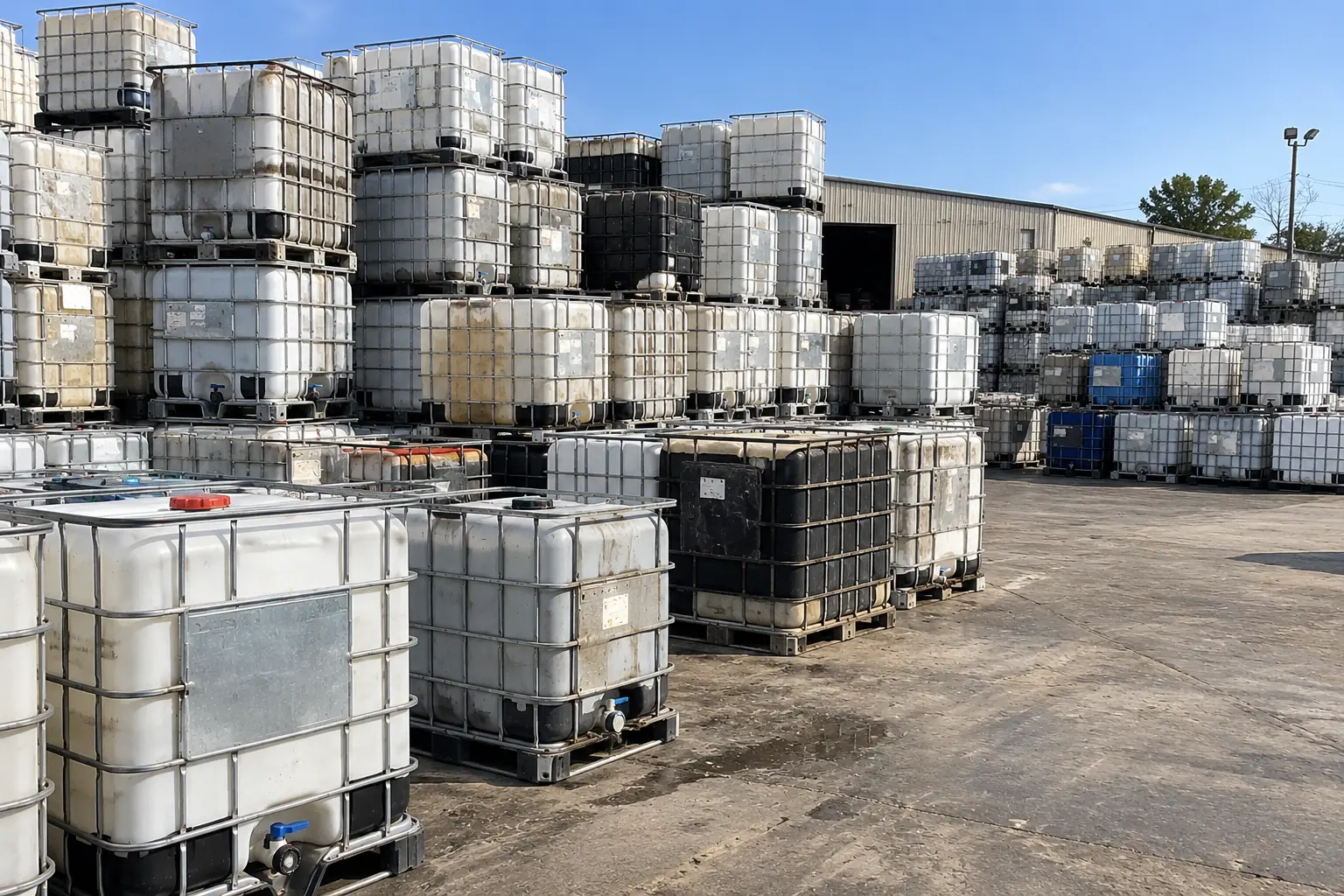
Grades, side by side
Grade cannot be judged from across the room.
A row of used totes like this can hold units of very different grades — some fit for demanding service, some fine for farm or site water, and some that should be scrapped.
You cannot tell which is which from a distance. Grade is judged with a flashlight against the wall, a check at the cap and a close look at each base corner — not from a photograph.
What you can see is the thing buyers often overpay to avoid: yellowed and stained bottles. That colour is usually dye that migrated into the polymer. Washing will not remove it, and on its own it generally does not weaken the bottle — though it is a clue to prior contents worth asking about.
Application matrix
Which grade each job actually needs.
Work from the application, not from the grade. Many overspends come from choosing a letter before describing the work. General guidance only.
| Application | Minimum grade | Why | Buying above it gets you |
|---|---|---|---|
| Food ingredients | New, or documented food-grade history | Provenance, not condition; check current regulations | Nothing — grade is not food safety |
| Potable water, emergency stock | New or rebottled, with documentation | Provenance; check current regulations | Nothing |
| Livestock drinking water | New, rebottled or documented history | Provenance | Nothing |
| Resold in the container | Rebottled | Your customer sees the wall | Nothing |
| Pharmaceutical adjacent | New or rebottled | Extractables and provenance | Nothing |
| Industrial chemistry, critical | Reconditioned A | Clear wall aids inspection | Cosmetics |
| Coatings and inks | Reconditioned A or rebottled | Colour carryover risk | Cosmetics |
| Nutrient solution, hydroponic | New, rebottled or documented history | Crop contact | Nothing |
| Liquid fertiliser | Reconditioned B | Crop does not see the container | Cosmetics only |
| Field and irrigation water | Reconditioned B or C | Nothing sees the container | Cosmetics only |
| Glycol and coolant loops | Reconditioned A or B | Closed loop | Cosmetics only |
| De-icing brine | Reconditioned C | Applied to a road | Cosmetics only |
| Wash water and stormwater | Reconditioned C | Waste stream | Cosmetics only |
| Dust suppression | Reconditioned C | Applied to ground | Cosmetics only |
| Site barriers and ballast | Scrap-grade, structurally sound | Holds water, stands up | Cosmetics only |
Grading yourself
A scoring sheet you can take to a seller.
Print it, take a flashlight and a tape measure, and score a sample. Treat any unit scoring a single Fail as a reject regardless of everything else.
| Check | Pass = A | Pass = B | Pass = C | Fail |
|---|---|---|---|---|
| Crazing under a raking light | None | None | None | Any |
| Stress-whitening at corners or outlet | None | None | None | Any |
| Odour at the open cap | None | None | Faint | Solvent, petroleum or sour |
| Bottle clarity | Clear to light haze | Light stain or shadow | Visible staining | Opaque deposit |
| Wall surface | No scuffing | Light scuffing | Surface damage, wall intact | Gouge you can catch a nail in |
| Transferable film on a white cloth | None | None | None | Any |
| Cage weld points | Sound, galvanising intact | Sound, light surface rust | Sound | Heavy corrosion or section loss |
| Cage geometry | Square | Straightened, square | Functional | Broken weld |
| Base corners | Rigid | Rigid | Rigid | Crack, flex or pale stress line |
| Outlet sealing face | Flat, undamaged | Flat | Flat | Distorted |
| Hardware present | Both fitted | Both fitted | Either | Outlet left open long-term |
| Label legible | Yes | Yes | Partial | Painted over |
Language
Grade terms other sellers use, and what they usually mean.
Sellers use different vocabulary. This is a rough translation table, offered with the caveat that only written criteria actually bind anybody.
| You are offered | Usually means | Ask |
|---|---|---|
| Grade A | Clear wall, straight cage — or the top price tier | What are the written criteria? |
| Grade B | Some staining — or the middle tier | Same question |
| Grade C | Visible staining — or whatever is left | Same question |
| Food grade | Should mean documented history or a new bottle | What was in it, how do you know, and what documentation comes with it? |
| Rebottled | New bottle in an old cage | Is the cage inspected, and to what standard? |
| Reconditioned | Should mean washed, tested, re-valved | What chemistry, verified how? |
| Refurbished | Non-standard; usually means reconditioned | What was actually done? |
| Cleaned | Rinsed | With what, at what temperature, after what? |
| Washed | Could be either | Same question |
| Triple rinsed | Rinsed three times, probably cold | What preceded the rinses? |
| Like new | Marketing | Nothing; it is not a grade |
| Good condition | Marketing | Nothing; it is not a grade |
| Used | Honest, at least | What grade, by what criteria? |
| Unwashed / as-is | Honest and often the right purchase | What was in it? |
Grading questions
Is IBC tote grading standardised across the industry?
No, and this is the single most important thing to understand about it. There is no governing body, no published standard and no enforcement. 'Grade A' means whatever the seller who wrote it decided it means. Some sellers apply rigorous written criteria; others use the letter as a pricing tier. Always ask a seller to state their criteria in writing — a seller who cannot is telling you something.
What is the difference between Grade A and rebottled?
Grade A describes a used bottle that inspects clean — clear to light haze, no crazing, no stress-whitening, no odour. Rebottled means the bottle is brand new. A Grade A tote may carry faint evidence of its history; a rebottled one has none because it has none. Rebottled usually costs more and is often the better answer wherever the bottle's prior contents genuinely matter.
Does grade affect whether a tote is food safe?
Not directly, and conflating the two causes real problems. Grade describes physical and cosmetic condition. Food suitability is a question about documented prior contents and material suitability. A pristine Grade A tote that held an unknown industrial chemical is not a food container. For any food use, ask the supplier for documentation and check current regulations.
Should I ever buy Grade C?
Often. In a typical grading scheme, Grade C units must pass the same leak test as Grade A — the difference is cosmetic and geometric. For brine, stormwater, wash water, dust suppression, construction water or anything where nobody looks at the container, Grade C is often the sensible purchase. Confirm the seller's criteria in writing.
What should make me walk away from a lot?
Crazing, stress-whitening, a persistent odour, a cracked pallet base, corrosion at the cage weld points, a missing or illegible label where the application needs provenance, or a seller who will not put their grade criteria in writing. Any one of those is a good reason to decline.
Keep reading