Services · Move
Pickup and delivery, arranged through partner suppliers.
Pickup and delivery are available through partner suppliers in our network. A tote is a tall, top-heavy, thin-walled container, so how it is loaded and received matters. This page covers what to plan for on your end.
The short answer
Pickup and delivery are available through partner suppliers. Tell us both locations, the quantity and whether you have a dock or forklift, and a partner supplier follows up with a quote. Pricing is by quote from partner suppliers; availability depends on your location.
Options
Common ways totes are moved.
The partner supplier picks the method. Knowing the options helps you describe what you need.
| Method | Typical use | Watch out for |
|---|---|---|
| Less-than-truckload (LTL) | A few totes | Handling at cross-docks; ask for no top-loading |
| Partial truckload | A larger lot that does not fill a trailer | Can make sense once LTL gets expensive — ask |
| Full truckload | A trailer's worth of totes | Needs room for a full-size trailer at both ends |
| Double-stacked empties | Empty totes only | Requires sound cages and intact bases |
| Supplier pickup | Selling used totes | Have units drained, capped and accessible |
Receiving totes without a dock
This is the question most likely to derail a delivery on the day. Work through it before you order, not when the truck is outside.
You have a forklift
Easiest case. Confirm the rating against the loaded weight, confirm the forks reach 48 inches, and confirm the approach is on the right face if the base is two-way.
You have a dock but no forklift
A pallet jack will move an empty tote and many loaded ones on a smooth floor. Check your jack rating and check that the base has fork pockets a jack can enter.
You have neither
Liftgate delivery. The driver lowers the unit to ground level and you take it from there with a pallet jack. Liftgates have weight ratings, so loaded units of dense product may not qualify. Empty units usually are not a problem.
You are a residential or rural address
Say so in the request. Trailer access, turning radius and surface all matter, and a full-size trailer that cannot turn around is an expensive afternoon for everybody. A smaller truck may be an option — ask the supplier.
How totes get damaged in transit
Much of it is preventable, and much of it happens during loading and unloading rather than on the road.
- Side-loading the cage. Forks entering anywhere other than the pallet pockets bend bars and break weld points.
- Setting down hard. Composite bases can crack under impact and the crack is often invisible until the unit is loaded.
- Unstrapped empties. A light unit moves more than a heavy one when a trailer bounces. Empties need their own restraint.
- Rotated units. A tote set at an angle to the trailer wall can walk under vibration and end up leaning on its neighbour.
- Top-loading at a cross-dock. LTL carriers stack freight on whatever is flat. A tote cage is not designed to carry other freight. Request no top-load on every LTL booking.
Read the pallet and stacking guide before your totes ship.
Coverage
Requests from across the United States.
Requests come from across the United States; availability depends on partner suppliers. For long distances, buying from a supplier closer to you can make more sense than shipping — say what matters to you in the request.
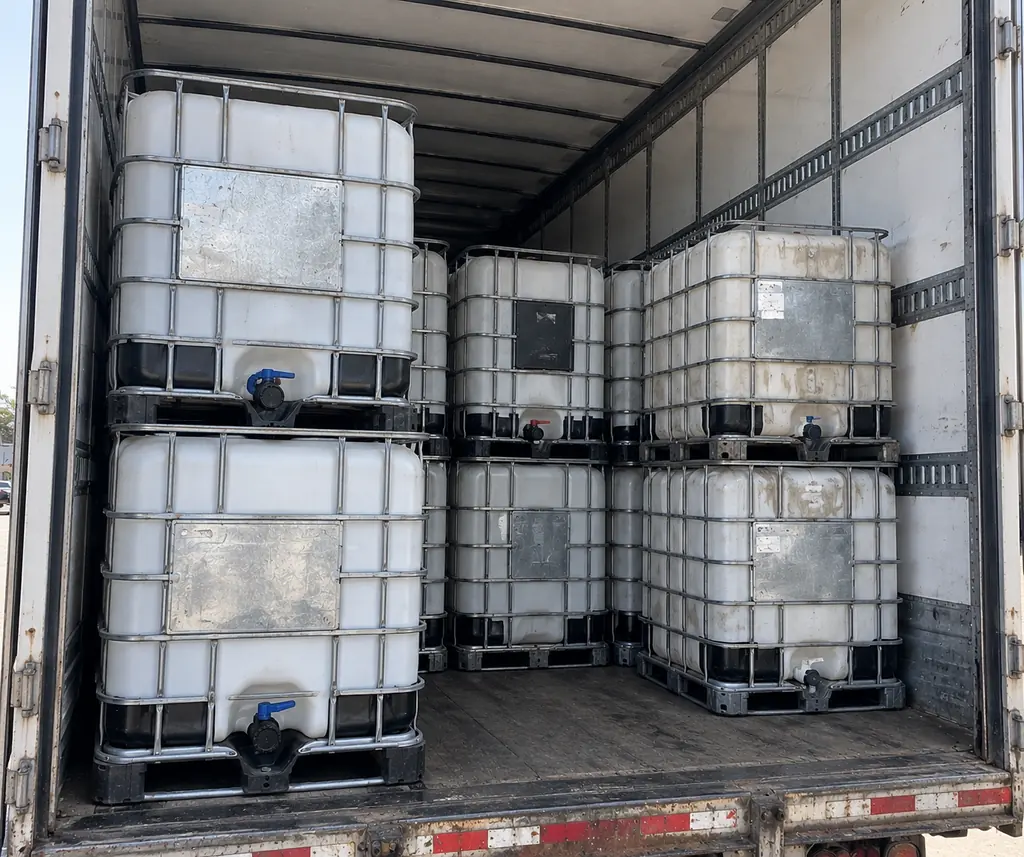
A loaded trailer
What a well-built load looks like.
Look at the alignment. Every base is square to the trailer wall, nothing is rotated, and the rows run nose to tail rather than staggered. There is little spare width in a standard van, so a unit set at even a small angle has room to shift — and once it shifts it leans on its neighbour.
The upper tier in a load like this should be empty units. Stacking loaded totes adds risk: road vibration, an unseen crack in a lower base and a hard brake are how a load fails. Loaded totes also reach a trailer's weight limit well before they fill the floor.
Photographing a load before the doors close — and again on arrival — is a simple habit that settles damage questions quickly. Ask for photos when you book.
Receiving
Work this out before you order, not on the day.
A truck that arrives unable to unload means a wasted trip. These questions settle it.
| You have | Works? | What to specify | Limit |
|---|---|---|---|
| Dock and forklift | Yes | Nothing | Forklift rating vs gross weight |
| Dock, pallet jack only | Yes | Nothing | Jack rating |
| Grade-level door, forklift | Yes | Note there is no dock | Ramp or forklift reach |
| Grade level, no forklift | Liftgate | Liftgate delivery in the request | Liftgate weight rating |
| Gravel or unpaved yard | Usually | Surface and approach | Trailer may need hard standing |
| Residential address | Sometimes | Residential delivery, smaller truck | Turning radius, overhead cables |
| Narrow access or low canopy | Depends | Height and width in feet | A full-size trailer needs real room |
| Nothing — no dock, no forklift | Liftgate, empties | All of the above | Loaded units may not qualify |
Pickup and delivery questions
How much does it cost to ship an IBC tote?
Pricing is by quote from partner suppliers. Cost depends on distance, quantity, whether the totes are empty or loaded, and what equipment is needed at each end. Include both locations, the quantity and your receiving setup in the quote request so the supplier can price it accurately.
Do I need a forklift to receive totes?
You need a forklift, a dock, or a liftgate delivery. A 275-gallon tote filled with water weighs well over 2,000 lb and cannot come off a trailer by hand. Liftgates have weight ratings, so loaded units of dense product may not be liftgate-eligible — check with the supplier. Tell us your receiving situation in the request.
Can totes be shipped full?
That depends entirely on what is in them. Many liquids are regulated for transport and need a correctly rated, correctly marked container and a qualified carrier — check current regulations. Partner suppliers generally move empty totes; ask about loaded shipments when they follow up.
How long does delivery take?
Timing depends on the partner supplier, the distance and their carrier schedule. A partner supplier follows up with your quote and can tell you what to expect for your location. Requests come from across the United States; availability depends on partner suppliers.