Products · New bottle
New bottle.
Old steel.
A rebottled IBC is the trade's best-kept compromise: a brand-new, never-filled HDPE bottle seated into a cage and pallet that already exist. You get an unstained interior with no prior-contents question — and a steel cage that did not have to be made again.
The short answer
A rebottled tote pairs a new HDPE bottle with a reused, inspected cage and pallet. Interior is as-new; exterior shows wear. It typically costs less than new and is a common choice for food-adjacent and resale applications. Pricing is by quote from partner suppliers.
Why it exists
The bottle wears out long before the cage does.
Understanding that one asymmetry explains most of the economics of tote reuse.
An HDPE bottle is a consumable with a long fuse. Ultraviolet light embrittles it. Some solvents swell it. Repeated fill-and-drain cycles stress the corners. Certain chemistries — particularly aromatic solvents and anything that polymerises — stain or permeate the wall in a way washing may never fully reverse.
The galvanised cage has none of those problems. Barring physical impact or serious corrosion at the weld nodes, it can outlast several bottles. A steel or composite pallet base can last a long time too.
So discarding the whole unit when the bottle fails throws away the heavier steel component because the lighter plastic one wore out. Rebottling avoids that.
When rebottled is the right call
- Food, beverage or potable water. A new bottle removes the prior-contents question. Ask the supplier for documentation and check current regulations.
- You resell in the container. Your customer sees the inside. Stained walls cost you credibility even when they are harmless.
- Colour or clarity matters. Level visibility through a clean natural-HDPE wall is much better than through a stained one.
- You need a UN-marked unit. Some rebottled assemblies carry a UN marking; ask the supplier what the unit is marked for.
- Sensitive chemistry. Anything where trace residue from a previous product is a genuine risk rather than a theoretical one.
The build
What typically happens between an empty cage and a sealed unit.
Processes vary by supplier. This is the usual sequence, and a good set of questions to ask.
- 01
Cage teardown & inspection
The old bottle is removed and sent for recycling where possible. The cage is checked at the weld nodes for corrosion, cracking and deformation. Cages that fail are not reused.
- 02
Straighten & repair
Bent bars are pressed back, the pallet deck is repaired or replaced, and galvanising may be touched up at bare welds. Badly corroded cages should not proceed.
- 03
Seat the new bottle
A new HDPE bottle is lowered in, the outlet is aligned, and the valve and cap are fitted, ideally with fresh gaskets in a compound that suits your liquid.
- 04
Test & mark
Suppliers typically leak test the unit and record a serial. Any UN marking depends on the assembly and its testing — ask the supplier.
Specifications
Common rebottled configurations.
| Config | Capacity | Bottle | Cage / base | Outlet |
|---|---|---|---|---|
| 275 standard | 275 gal / 1041 L | New natural HDPE | Galvanised steel, composite or steel base | 2" butterfly, S60x6; 6" cap |
| 275 food-contact resin | 275 gal / 1041 L | New bottle; ask for resin documentation | New gaskets | 2" butterfly, EPDM, tamper seal |
| 330 standard | 330 gal / 1249 L | New natural HDPE | Galvanised steel, steel base | 2" butterfly, S60x6; 6" cap |
| 330 food-contact resin | 330 gal / 1249 L | New bottle; ask for resin documentation | New gaskets | 2" butterfly, EPDM, tamper seal |
| 275 UN-marked | 275 gal / 1041 L | New HDPE | Ask the supplier about the assembly marking | 2" ball valve, FKM option |
Rebottled vs. reconditioned, honestly
Buy the less expensive one when it is correct. Reconditioned keeps the original bottle and typically costs less. It also reuses more of the unit, because the polyethylene stays a container instead of becoming regrind.
Rebottling wins on three axes: prior-contents certainty, interior appearance, and confidence in the wall for sensitive chemistry. If none of those three matter to your application, consider reconditioned and put the difference into a better valve.
If your liquid is fertiliser and your customer never sees the tote, you are paying a premium for a clean wall that nothing will ever notice.
| Rebottled | Reconditioned | |
|---|---|---|
| Bottle | New, never filled | Original, washed and tested |
| Prior-contents question | Eliminated | Documented at best, not eliminated |
| Interior appearance | As-new | Clean, possibly shadowed |
| Typical relative price | Higher | Lower |
| What is reused | Cage and pallet | Cage, pallet and bottle |
| Food-use path | Simpler — ask for documentation | Only with documented prior contents |
What to expect
New inside, honest outside.
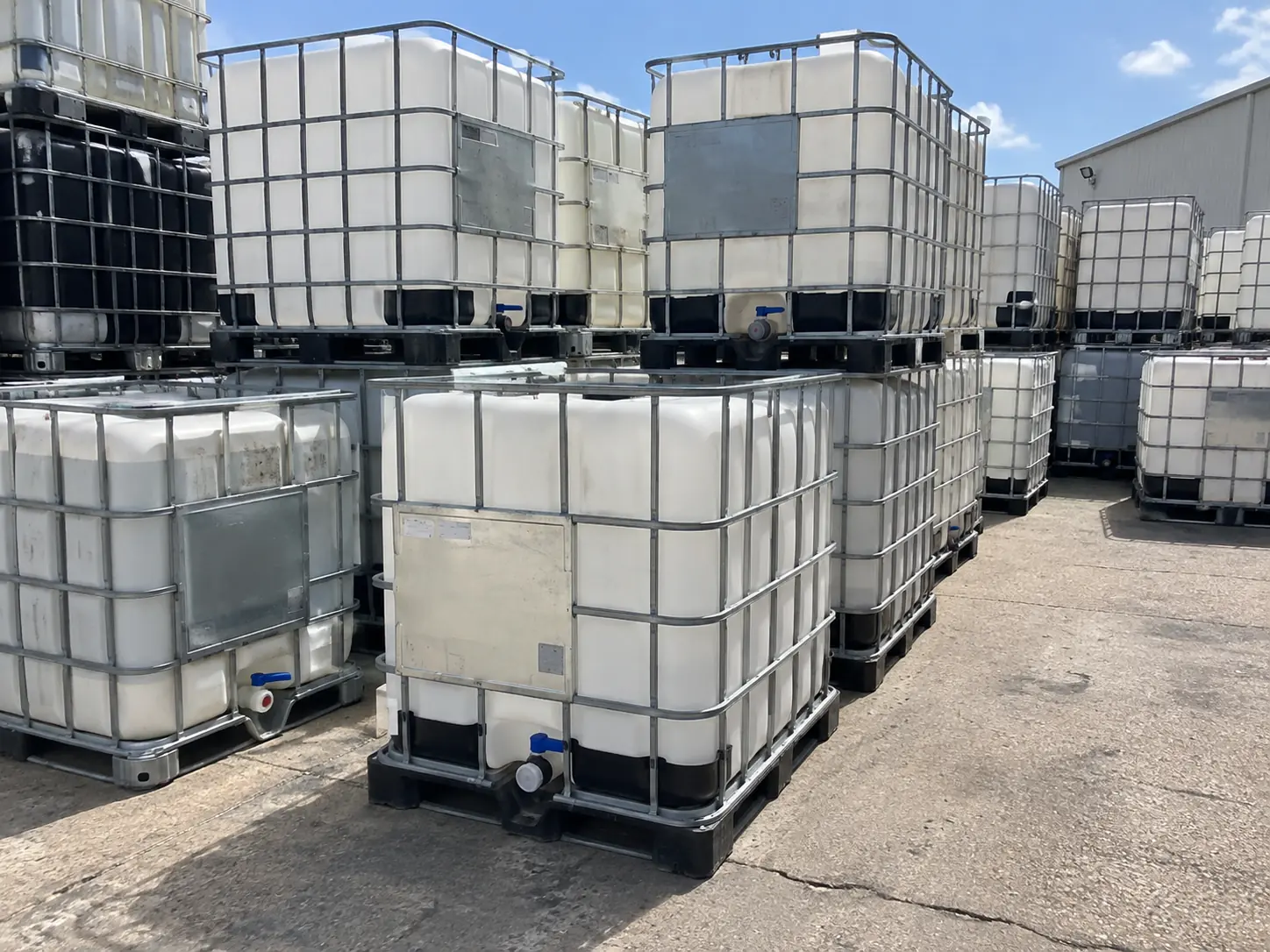
The interior of a rebottled unit is as new, because the bottle is new. What is not new is the steel around it, and that is the entire point.
A galvanised cage is made from steel wire that was mined, smelted, drawn and hot-dipped. It also tends to wear out last. Throwing it away because the bottle is finished is the waste that rebottling exists to prevent.
Cosmetically you may see wear on the cage — scuffs, a straightened bar, galvanising that has dulled. On a structurally sound cage none of that affects the unit.
Cage inspection
Not every cage deserves a new bottle.
Rebottling is only worth doing into steel that has real life left. These are the checks a cage should pass — useful to ask a supplier about, and to apply to your own cages.
| Check | Pass | Reject |
|---|---|---|
| Weld node condition | Sound, full section, galvanising intact | Corrosion bloom or section loss at any node |
| Weld integrity | No cracking at any intersection | Any cracked weld |
| Cage geometry | Square; light racking correctable | Deformation that has opened a node |
| Bar condition | Surface rust acceptable | Section loss, kinked bars, missing members |
| Base interface | Cage seats flat on the base | Twisted or distorted footing |
| Galvanising | Dulled acceptable; touch-up at bare welds | Widespread white rust with substrate attack |
Why the cage matters more than the bottle
The galvanised cage is the heavier component of a composite IBC, and steel takes a lot of energy to make. It is also the component that tends to wear out last. Barring impact damage or corrosion at the weld nodes, a cage can outlast several bottles.
Discarding the whole unit when the bottle fails throws away the heaviest, longest-lived component because the lighter, shorter-lived one wore out. Rebottling gives you a container with no prior-contents question, and reusing the cage avoids making a new one.
When rebottling beats washing
Washing is usually cheaper than a new bottle. The question is whether the wash actually works.
- Residue clears easily: washing the original bottle (reconditioning) is usually the better value.
- Difficult residue: repeated washing costs more each time and may still not clear the bottle, so a new bottle starts to make sense.
There are also cases where rebottling is the only sensible answer: staining where the customer sees the container, any move from industrial into food use, crazing or stress-whitening, and prior contents that rule out reuse of the bottle.
Bottle options
What goes into the cage.
All new. The choice is about resin, colour, wall and marking rather than about quality.
| Bottle | Capacity | Documentation | Right for |
|---|---|---|---|
| Standard natural HDPE | 275 or 330 gal | — | General industrial service |
| Food-contact resin, natural | 275 or 330 gal | Ask the supplier; check current regulations | Food, beverage, potable water |
| UN-marked assembly | 275 gal | Ask what the assembly is marked for | Regulated transport — check current regulations |
| Carbon-loaded (black) or UV-stabilised | 275 gal | — | Light-sensitive product or outdoor storage |
| Heavier wall | 275 gal | — | High-cycle service, rough handling |
Rebottled totes — common questions
Is a rebottled IBC tote the same as a new one?
Inside, functionally yes — the bottle has never held anything. Outside, the cage and pallet have history: scuffs, straightened bars, dulled galvanising. Whether a rebottled unit carries a UN marking depends on how the assembly was built and tested, so ask the supplier and check current regulations if you ship regulated material. What you give up is mostly cosmetic; what you typically gain is a lower price, and reusing the cage avoids making a new one.
Can rebottled totes be used for food?
A new bottle removes the prior-contents question, which is a main reason people choose rebottled for food use. Whether a particular unit is suitable for your product depends on the bottle resin and the supplier's handling, so ask the supplier for documentation and check current regulations. Our food grade vs. industrial guide explains what to ask for.
How long does a rebottled tote last?
The bottle is new, so its clock starts at zero; its service life depends heavily on UV exposure and what you put in it. The cage is usually the limiting component, which is why it matters that the supplier inspects it properly. A cage with real corrosion at the weld nodes should not get a new bottle.
How soon can I get rebottled units?
Rebottled units are often built to order, so availability depends on the partner supplier and on cage stock. Submit a request with your quantity, configuration and timing, and a partner supplier follows up.
Keep reading